
Regenerative Agrotourism: Why 2026 Luxury Travelers are Prioritizing "Eco-Farm" Workstays Over Traditional High-End Resorts.
This article explores the 2026 travel revolution where Ultra-High-Net-Worth Individuals (UHNWIs) are trading infinity pools for permaculture plots, seeking "Intentional Restoration" through hands-on ecological labor and community-led farmstays.
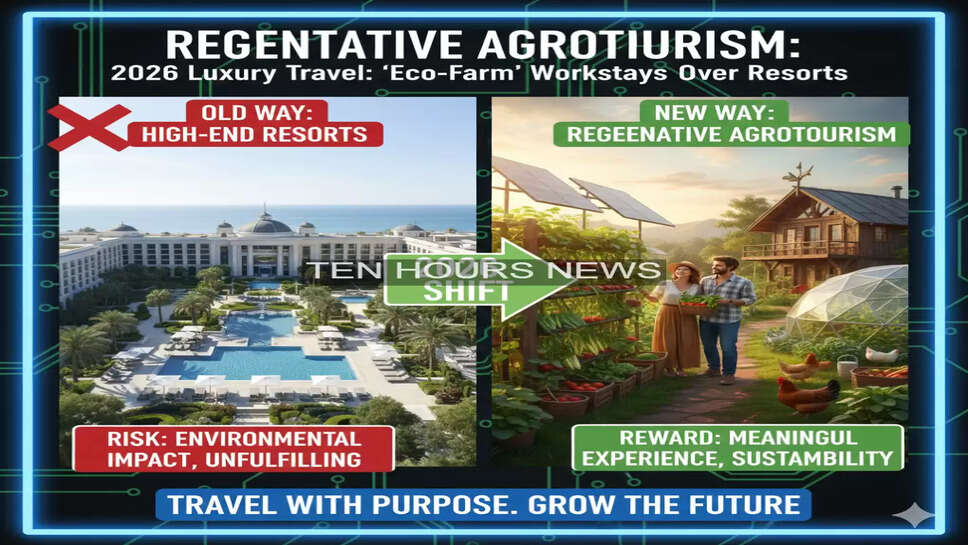
By January 2026, the definition of a "five-star" experience has undergone a radical re-evaluation. For the modern luxury traveler, opulence is no longer measured by the thickness of a marble countertop or the number of staff per guest. Instead, the ultimate status symbol of 2026 is Impact. This shift has propelled "Regenerative Agrotourism" from a niche lifestyle choice into a dominant force in the high-end travel market. Travelers who once frequented secluded beachfront resorts are now booking month-long "workstays" at regenerative eco-farms, where they swap morning spa treatments for soil restoration workshops and afternoon cocktails for heirloom seed harvesting. This is not "voluntourism" of the past; it is a sophisticated, high-tech integration of luxury living and active environmental stewardship.
The driver behind this trend is "Urban Fatigue" coupled with a deep-seated desire for Intentional Restoration. In an era of hyper-digitalization, the 2026 elite are seeking tangible, physical connections to the earth. They are rejecting "greenwashed" hospitality in favor of transparent, measurable regeneration. According to 2026 industry data, over 70% of luxury travelers now prioritize stays that can prove a "net-positive" impact on the local ecosystem. At an eco-farm workstay, the traveler isn't just a spectator; they are a contributor to the land's recovery.
From Extraction to Stewardship: The 2026 Luxury Mandate
Traditional luxury resorts have long been criticized for their "extractive" nature—consuming local resources and energy while providing a sterilized, isolated experience. Regenerative agrotourism in 2026 flips this model. These "Agri-Resorts" are built on the principles of Circular Ecology, where every guest activity is designed to feed back into the farm's productivity.
A traveler staying at a high-end olive grove in Tuscany or a coffee finca in Colombia might spend their morning working with biologists to monitor soil microbiome health using AI-powered sensors. This "work" is framed not as a chore, but as an exclusive, educational privilege—an "Immersive Scientific Tourism" experience. By participating in the actual labor of the farm, guests gain a level of "Deep Place Intelligence" that a standard hotel could never provide. They leave with a literal "legacy" of trees planted or hectares restored, a feeling of accomplishment that traditional leisure cannot match.
The Rise of the "Agrihood" and Modular Workstays
In 2026, the physical infrastructure of these stays has evolved to support the "Neo-Nomad" lifestyle. High-end eco-farms are now featuring Modular Eco-Villas—plug-and-play, off-grid units that offer every modern comfort (6G connectivity, AI-optimized climate control, and artisanal interiors) while maintaining a zero-footprint ethos. These units allow farms to scale their hospitality capacity without permanent damage to the landscape.
This infrastructure supports the "Work-from-Farm" trend. Many professionals in 2026 are choosing to relocate their offices to these regenerative hubs for weeks at a time. The morning "commute" is a walk through a silvopasture system, and lunch is sourced entirely from the fields outside their door. This "Soil-to-Soul" wellness approach treats agriculture as a form of therapy, reducing cortisol levels and boosting cognitive function through direct contact with nature and "Mycobacterium vaccae"—the healthy soil bacteria known to improve mood.
The "New Gold": Soil Health and Gastronomic Heritage
For the 2026 traveler, the "New Gold" is nutrient density and genetic heritage. Traditional luxury dining often relies on global supply chains; regenerative agrotourism relies on the Hyper-Local. Guests at these estates are participating in the revival of "Lost Ingredients"—heirloom varieties of grains, fruits, and vegetables that have been brought back through regenerative practices.
In January 2026, the Michelin Guide officially introduced its "Regenerative Star" for farmstays that demonstrate exceptional soil-building and biodiversity metrics alongside culinary excellence. This has created a new competitive tier in the luxury market. Travelers are now booking stays based on a farm’s "Carbon Sequestration Score" and the rarity of its seed bank. The act of eating becomes a political and environmental statement—a celebration of the "Planetary Consciousness" that defines the 2026 traveler.
Conclusion
Regenerative agrotourism is the final evolution of the "Green Travel" movement. It has successfully decoupled "luxury" from "excess," proving that the most indulgent experience one can have in 2026 is one that heals the planet. By inviting guests to be active stewards rather than passive consumers, eco-farm workstays are providing a sense of purpose and connection that traditional high-end resorts are struggling to replicate. As we move through 2026, the success of these models suggests that the future of luxury travel isn't about escaping the world—it's about actively rebuilding it, one farmstay at a time.
FAQs
What exactly is "Regenerative Agrotourism"? It is a form of travel where guests stay on working farms that use regenerative agriculture (practices that restore soil health and biodiversity). Guests often participate in hands-on farm activities as part of their "workstay" experience.
Do I actually have to work during my stay? "Work" is usually optional and framed as an educational or wellness experience. However, the 2026 trend shows that luxury travelers want to participate in activities like planting, harvesting, or soil monitoring because it provides a deeper sense of connection and purpose.
How does this differ from a traditional farmstay? Traditional agritourism is often about observation and leisure. Regenerative agrotourism focuses on improvement—the stay is designed to leave the land and community better than it was found, often using high-tech tools to measure impact.
Is it really "luxury" if I'm working in the dirt? In 2026, yes. The "luxury" comes from the exclusivity of the location, the high-end off-grid accommodations, the Michelin-level nutrient-dense food, and the rare access to scientific and agricultural experts.
Where can I find these stays in 2026? Leading destinations include the "Patagonia Park Network" in Chile, the "Tiaki Promise" estates in New Zealand, the "Datai Pledge" areas in Malaysia, and emerging "Agrihoods" near major hubs like Bangalore, Mumbai, and New York.