America’s 250th Anniversary: Economic Opportunities for US Small Businesses in Host Cities
Jan 8, 2026, 04:05 IST
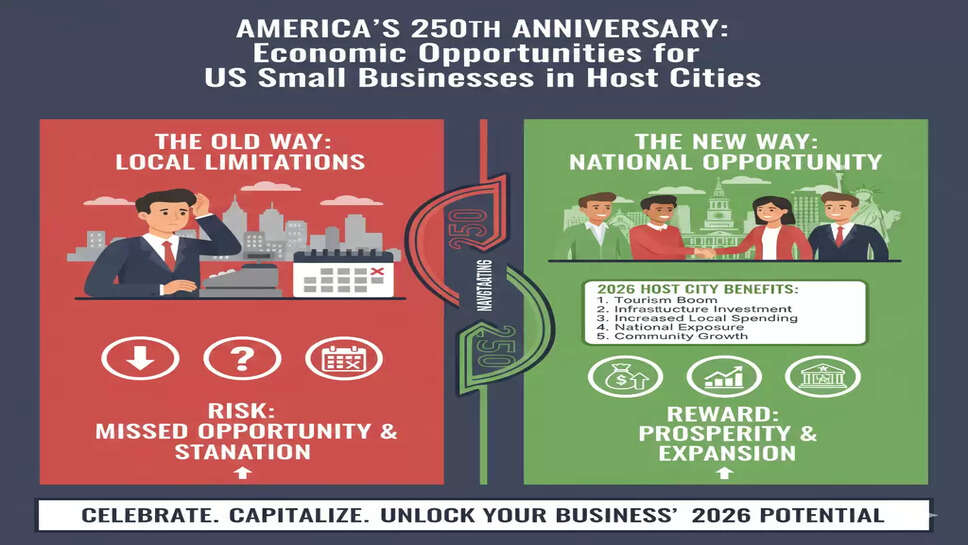
As the calendar turns to early 2026, the United States is standing on the precipice of its most significant historical milestone since the Bicentennial of 1976. The "Semiquincentennial"—the 250th anniversary of the signing of the Declaration of Independence—is not merely a moment for reflection and fireworks; it is a massive catalyst for economic revitalization. For the American small business owner, particularly those located in the "Signature Cities" of Philadelphia, Boston, New York, Washington D.C., and Charleston, the year 2026 represents a once-in-a-generation opportunity to capture a share of a projected multi-billion-dollar tourism and retail surge. With the federal government’s "Freedom 250" initiative in full swing and the tax-favorable environment created by the One Big Beautiful Bill (OBBBA) Act, the upcoming July 4th celebrations are being positioned as the ultimate "Grand Opening" for a new era of American commerce. This article explores the specific pathways for small business success as the nation prepares to celebrate its quarter-millennium of independence.
The "Signature Cities" and the Tourism Super-Cycle
The 2026 economic landscape is defined by a "Tourism Super-Cycle" that aligns the 250th anniversary with several of the world’s largest sporting and cultural events. Philadelphia, often cited as the "Birthplace of America," is serving as the spiritual heart of the celebration. The city is not only hosting the primary Semiquincentennial festivities but is also home to the 2026 MLB All-Star Game, the PGA Championship, and matches for the FIFA World Cup 26.
-
Philadelphia’s "Wawa Welcome America" Supersized: In 2026, the city’s traditional festival has been extended from Juneteenth (June 19) all the way through July 4th, creating a 16-day window of peak consumer activity. Local small businesses in the Old City and South Philly corridors are reporting record-high advanced bookings for hospitality and experiential services.
-
Boston’s "Cradle of Liberty" Focus: Boston is leveraging its role in the early Revolution with events like "Tall Ships & Tea Leaves," attracting millions of visitors to its historic harbor. Small maritime and tour operators are finding new revenue streams through "Immersion Packages" that blend history with modern luxury.
-
Washington D.C. as the National Stage: The nation's capital is the "Centerstage" for the federal celebration, with a year-long calendar of events titled "America’s Grand National Celebration." This includes the massive "National Scrollathon" at the Kennedy Center and expanded programming on the National Mall that is expected to draw the largest crowds in the city's history. For small businesses, these events create a desperate need for localized logistics, pop-up retail, and specialized food services that large corporations often lack the agility to provide.
OBBBA Act: The Financial Engine of 2026 Small Business
The ability of small businesses to scale up for the 250th anniversary has been significantly bolstered by the One Big Beautiful Bill (OBBBA) Act passed in 2025. This legislation was specifically designed to ensure that the "little guy" could compete with larger entities during the 2026 economic boom.
-
Permanent Pass-Through Deduction: One of the most critical wins for small businesses in early 2026 is the permanence of the 20% pass-through deduction. This allows sole proprietorships, LLCs, and S-corporations to keep a larger portion of their anniversary-related profits, providing the liquid capital needed to hire seasonal staff or upgrade facilities.
-
100% Bonus Depreciation: Under the OBBBA, businesses can immediately deduct the full cost of capital equipment purchased to prepare for the 250th rush. This includes everything from new kitchen equipment for restaurants in Charleston to mobile POS systems for street vendors in New York City.
-
Incentives for Infrastructure: The OBBBA Act has also funneled billions into local "Heritage Infrastructure," funding the restoration of historic districts where small businesses operate. This has increased foot traffic in previously overlooked areas, allowing local boutiques and cafes to thrive in a "Beautified America" environment.
The Rise of "Agentic AI" in Managing the Surge
Small businesses in 2026 are not just working harder; they are working smarter through the use of Agentic AI. Unlike the simple chatbots of years past, the AI agents of 2026 are capable of managing entire workflows, which is essential for businesses facing the logistical nightmares of massive city-wide festivals. A local bakery in Boston, for example, can use an on-device AI agent to automatically adjust supply orders based on real-time foot traffic data from the "Freedom 250" app. These AI tools can manage dynamic pricing for souvenirs, handle multilingual customer inquiries for international tourists, and even optimize delivery routes through 2026’s crowded city streets. Because this AI is "Agentic"—meaning it can take action without constant human prompting—it serves as a "Force Multiplier" for small teams, allowing a staff of five to perform with the efficiency of a staff of twenty.
Local Sourcing and the "Authenticity Premium"
A major trend for the Semiquincentennial is the consumer’s demand for "Authentic Americana." Tourists in 2026 are shunning mass-produced, overseas-made trinkets in favor of locally sourced, high-quality goods.
-
Makers and Artisans: Small-scale manufacturers in host cities are seeing a surge in demand for "Limited Edition 250" collaborations. Hand-forged ironwork from Pennsylvania or artisanal textiles from the Carolinas are fetching a premium price.
-
The "Small Town Showcase": Through initiatives like the Missouri Humanities Small Town Showcase, rural and small-town businesses are being linked to the larger "Signature City" hubs. This allows a small business in a town of 5,000 to sell its products in a major Philadelphia or DC marketplace, expanding its reach through the "National Digital Storefront" provided by the America250 commission.
-
Food and Beverage: Local breweries and distilleries are launching "Revolutionary Brews," utilizing ingredients that would have been found in 1776 but processed with 2026 precision. These businesses are benefiting from the OBBBA’s tax refunds for "domestic resource leveraging," making local production more profitable than ever before.
Challenges: Logistics, Supply Chains, and Security
Despite the optimism, the 2026 anniversary brings significant operational hurdles. Host cities are implementing some of the most stringent "Security Perimeters" in history, which can disrupt the "Last Mile" of delivery for small businesses.
-
Supply Chain Pressure: With the world’s attention on the US, global supply chains for certain materials are strained. Small businesses that did not utilize the OBBBA’s capital expensing rules in 2025 to stock up on inventory are facing higher costs due to 2026's elevated tariff environment.
-
Workforce Shortages: The demand for hospitality workers is at an all-time high. Many small businesses are turning to the OBBBA’s "Dependent Care" and "Retirement Benefit" incentives to attract and retain the staff needed to survive the July 4th crush.
-
Digital Security: As millions of transactions move through mobile wallets and AI-driven platforms, small businesses are investing heavily in "Knox-Level" cybersecurity to protect their customer data and their own digital sovereignty.