
The Year of Agentic AI: From Chatbots to Autonomous Decision-Makers
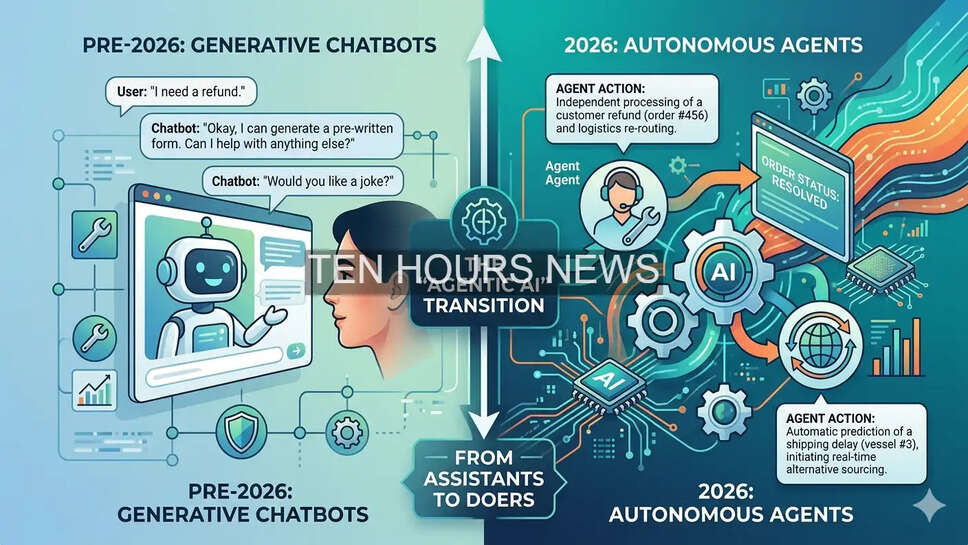
If 2024 and 2025 were the years of the "generative" boom, 2026 has officially been christened the Year of Agentic AI. The industry has moved beyond the "chat" interface, where AI simply responded to prompts with text. Today, we are seeing the mass deployment of Autonomous AI Agents—systems that don't just talk about tasks but actually execute them. Industry analysts predict that by the end of 2026, 40% of enterprise applications will have integrated these task-specific agents, a massive leap from the static assistants of the past.
The core difference in 2026 is agency. While a generative AI might summarize a supply chain report, an Agentic AI perceives a shipment delay, calculates the impact on inventory, negotiates with alternative suppliers via secure protocols, and reroutes the logistics—all without waiting for a human to hit "send." This shift from reactive assistance to proactive execution is fundamentally restructuring the modern digital workforce.
The Architecture of Agency: Generative vs. Agentic
Understanding the 2026 landscape requires distinguishing between the "brain" (Generative) and the "hand" (Agentic).
-
Generative AI (The Engine): Remains the core reasoning layer, used to summarize complex data and provide human-like communication.
-
Agentic AI (The System): Wraps that reasoning engine in a framework that includes memory, planning, and tool-use. It can navigate software, access databases, and make sequential decisions to reach a defined goal.
2026 Impact: Customer Service & Supply Chain
| Sector | 2025 (Generative Era) | 2026 (Agentic Era) |
| Customer Service | AI drafts a reply for a human to review and send. | Agent processes the refund and updates the CRM autonomously. |
| Supply Chain | AI flags a risk (e.g., a port strike) on a dashboard. | Agent initiates alternative sourcing and updates schedules in real-time. |
| Procurement | AI summarizes vendor contracts. | Agent monitors pricing and triggers reorders when stock hits 15%. |
| Logistics | AI predicts a delivery delay. | Agent reroutes the fleet and sends personalized updates to customers. |
The "Sim-to-Real" Supply Chain Revolution
In 2026, Agentic AI is most visible in Autonomous Procurement. These agents act as "digital employees" that monitor contract milestones and validate invoices without human intervention. By integrating with Digital Twins—virtual replicas of the entire supply chain—these agents can run millions of "what-if" simulations per second. If a disruption is detected, the AI doesn't just alert a manager; it chooses the most resilient workaround and executes the corrective action within predefined guardrails.
Data from this year shows this autonomous decision layer is helping organizations reduce logistics costs by up to 20% and cut forecasting errors by nearly half. The focus for leadership in 2026 has shifted from how to prompt the AI to how to govern it, ensuring these agents operate within safe legal and financial boundaries.
Conclusion
The Year of Agentic AI represents a permanent shift in how we define productivity. As of May 2026, the value of AI is no longer measured by how many words it can write, but by how many tasks it can complete. For businesses, this means transitioning from a world of "AI assistants" to a world of "AI workers." While humans remain the ultimate governors—setting the goals and high-level strategy—the day-to-day execution of complex, multi-step workflows is now firmly in the hands of autonomous agents.
FAQs
What is the difference between Generative AI and Agentic AI?
Generative AI focuses on creating content (text, images) based on a prompt. Agentic AI focuses on taking action and solving multi-step problems to achieve a specific goal.
How does Agentic AI help in customer service?
Instead of just answering questions, an agent can actually do the work—like changing a flight, processing a return, or updating an account—without needing a human to take over the keyboard.
Can Agentic AI work without human oversight?
It works with minimal oversight for routine tasks, but 2026 best practices still involve "Human-in-the-Loop" guardrails for high-stakes decisions, such as large financial transactions.
Is Agentic AI replacing human supply chain managers?
No. It is automating the repetitive parts—like monitoring ship locations and reconciling invoices—allowing managers to focus on high-level strategy and long-term vendor relationships.
What technology powers these agents in 2026?
Most agents use a Large Language Model (LLM) as their thinking center, combined with specialized software frameworks that allow them to use digital tools and maintain memory.
How much money can Agentic AI save companies?
Estimates from May 2026 show that fully integrated agentic systems can reduce logistics and distribution costs by 5% to 25% depending on the industry.