
The Space Summit 2026: Analyzing Singapore’s New Roadmap for Commercializing Low-Earth Orbit "Work-from-Space" Stations.
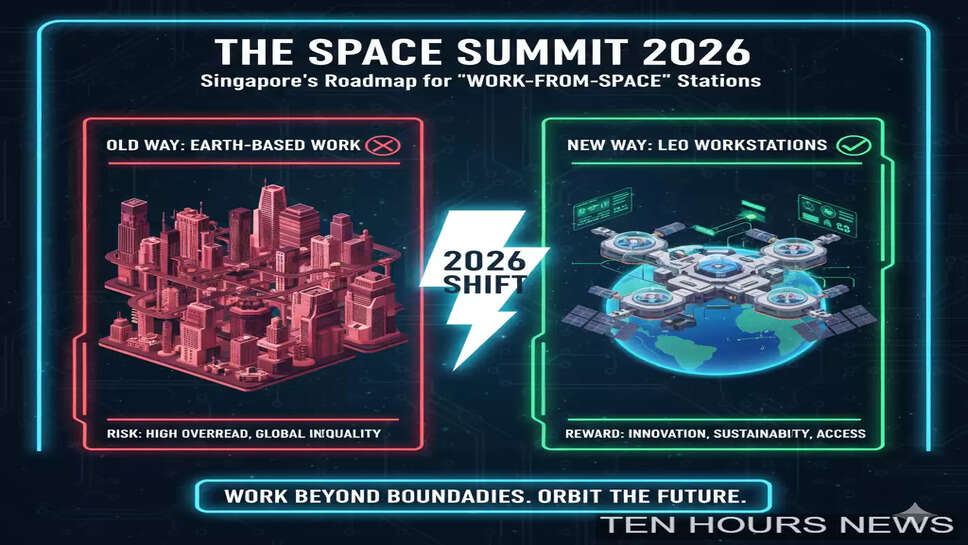
In 2026, the edge of the atmosphere is the new frontier for Singapore’s economic expansion. At the Space Summit 2026, the Office for Space Technology & Industry (OSTIn) officially launched its "Next Bound" strategy, backed by an additional S$60 million tranche (bringing total funding to over S$210 million). The goal is clear: to establish Singapore as the primary service and digital coordinator for the burgeoning era of private space stations. As the International Space Station (ISS) begins its phased retirement, a new crop of commercial destinations—from Vast’s Haven-1 (scheduled for launch in May 2026) to Airbus’s Starlab—requires a neutral, high-tech hub for data relay, orbital logistics, and regulatory oversight. Singapore has stepped into this role, leveraging its strengths in AI, connectivity, and international law.
The "Work-from-Space" Ecosystem: From Concept to Commerce
Singapore’s 2026 roadmap identifies "Work-from-Space" not as a sci-fi dream, but as a series of high-value industrial verticals. The summit highlighted three primary sectors that Singaporean firms are now leading:
-
Microgravity Manufacturing: Singapore-based startups are collaborating with international station builders to develop autonomous "mini-factories." These modules utilize the unique properties of LEO (lack of convection, vacuum, and weightlessness) to produce superior fiber optics, high-purity pharmaceuticals, and specialized semiconductors that are impossible to manufacture on Earth.
-
Continuous In-Orbit Connectivity: Firms like Addvalue and SpeQtral are providing the "communications backbone" for commercial stations. Their Inter-satellite Data Relay System (IDRS) allows space stations to maintain 24/7, high-speed encrypted links with Earth, enabling remote operation of orbital labs.
-
Autonomous Orbital Servicing: The roadmap emphasizes Singapore’s role in "Space Logistics." By 2026, local robotics firms are testing "Space Tugs" and refueling modules designed to extend the lifespan of commercial LEO assets, mimicking the nation’s historical role as a maritime refueling port.
The "Next Bound" Strategy: Investing in Orbital Talent
A major theme of the 2026 summit is the transition from hardware to Human Capital. Minister for Manpower Dr. Tan See Leng emphasized that the "Work-from-Space" economy requires a new class of "Orbital Professionals."
[Image: A infographic showing the 2026 Singapore Space Workforce: "70+ Companies, 2,000+ Professionals." It breaks down roles into "Satellite Architects," "Microgravity Scientists," and "Orbital Legal Experts."]
ST Engineering, a founding partner of the summit, has launched new talent pipelines to train engineers specifically in In-Space Infrastructure Management. This ensures that as private companies like Blue Origin and Voyager Space build their "orbital business parks," Singapore provides the skilled workforce to manage the ground-to-space data flows and the legal frameworks governing orbital intellectual property.
Global Collaboration: The "Neutral Space" Advantage
One of Singapore’s unique competitive advantages in 2026 is its status as a "Neutral Convener." The Space Summit 2026 has drawn space agencies from Brazil, Germany, Japan, and the UAE, alongside NASA and the European Space Agency (ESA).
-
Regulatory Clarity: Singapore is leading the dialogue on "Space Traffic Management" and "Orbital Sustainability."
-
Inclusive Innovation: Under the theme “New Frontiers: Shaping a Responsible and Inclusive Space Future,” the 2026 roadmap includes specific provisions for helping emerging space nations in Southeast Asia access LEO through shared Singaporean infrastructure.
Conclusion
The Space Summit 2026 has confirmed that the "Work-from-Space" era is officially open for business. Singapore’s new roadmap ensures that the nation remains indispensable to the global space economy, acting as the high-tech switchboard and logistics coordinator for everything happening 250 miles above our heads. As commercial space stations move from blueprints to launchpads throughout 2026, Singapore is perfectly positioned to be the primary port of call for the next trillion-dollar market.
FAQs
What is the "Next Bound" strategy? It is Singapore's 2025-2026 plan to invest S$210 million into space tech, focusing on maritime applications, climate monitoring, and the commercialization of in-space infrastructure.
When will the first commercial space station launch? The California-based startup Vast is scheduled to launch Haven-1, the first standalone commercial LEO platform, in May 2026.
Can Singaporean companies participate in space station building? Yes. Companies like Addvalue and Transcelestial already provide critical data-relay and laser-communication hardware used by international space station developers.
What is "Microgravity Manufacturing"? It is the production of goods (like ZBLAN fiber or protein crystals) in the weightless environment of space, which results in much higher quality and purity than can be achieved under Earth's gravity.
How much is the space economy worth in 2026? As of early 2026, the global space economy is estimated at approximately $700 billion, on a rapid trajectory toward $1.8 trillion by 2035.