
The “Agentic Economy” Pivot – How May 2026 Became the Turning Point for Autonomous AI Business Operations
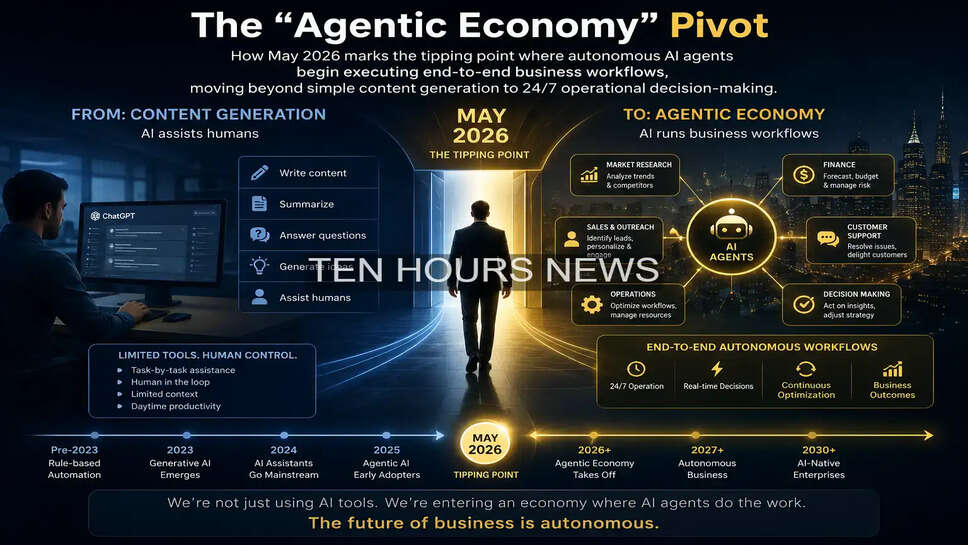
May 2026 is rapidly being recognized as the defining moment when artificial intelligence moved beyond experimentation and entered a completely new era of business transformation. This period marks the rise of the Agentic Economy, a system where autonomous AI agents no longer function merely as tools for writing emails, generating images, or summarizing reports. Instead, they actively execute end-to-end business workflows, make operational decisions, manage customer interactions, coordinate logistics, and optimize enterprise systems without continuous human supervision.
For years, AI was viewed primarily as a productivity assistant. Businesses used it to automate repetitive tasks or accelerate creative work. However, the developments unfolding in 2026 demonstrate something much larger. Organizations are now deploying intelligent AI agents capable of handling interconnected responsibilities across departments, operating continuously around the clock, and adapting dynamically to changing business conditions.
This transformation is not simply another technology trend. It represents a structural shift in the global economy, comparable to the rise of cloud computing, the internet revolution, or industrial automation. The Agentic Economy is changing how companies operate, compete, hire employees, and deliver services. As industries race to adopt autonomous systems, the world is witnessing the beginning of a new economic framework powered by intelligent digital agents.
Understanding the Agentic Economy
The term Agentic Economy refers to an ecosystem where autonomous AI agents independently execute complex workflows and business operations. Unlike earlier AI systems that required direct prompts and human oversight, modern AI agents can plan, reason, coordinate actions, analyze outcomes, and continuously improve performance.
These systems operate similarly to digital employees. They can communicate with software platforms, access databases, interact with customers, monitor market conditions, and even collaborate with other AI agents. In many organizations, multiple agents now work together in synchronized environments to manage entire operational chains.
For example, an AI sales agent may identify potential customers, generate outreach campaigns, analyze responses, schedule meetings, and coordinate with a separate finance agent that prepares contracts and payment structures automatically. Meanwhile, a logistics agent monitors inventory levels and shipping timelines in real time.
This interconnected automation model is fundamentally different from earlier generations of AI. Instead of supporting isolated tasks, AI agents now manage complete operational ecosystems.
Why May 2026 Became the Tipping Point
Several technological and economic developments converged in May 2026 to accelerate the adoption of autonomous AI systems worldwide.
First, AI reasoning capabilities improved dramatically. New large-scale models became capable of multi-step planning, memory retention, contextual decision-making, and adaptive learning. These improvements allowed AI agents to operate more reliably in dynamic environments.
Second, businesses faced increasing pressure to improve efficiency amid rising operational costs and economic uncertainty. Companies realized that autonomous AI could reduce expenses, accelerate workflows, and maintain continuous productivity without traditional time limitations.
Third, integration technology matured significantly. AI agents could now connect seamlessly with enterprise software platforms such as customer relationship management systems, accounting tools, supply chain networks, and communication applications.
Finally, public trust in AI systems improved as organizations implemented stronger governance frameworks, security measures, and human oversight protocols.
Together, these factors created the perfect environment for widespread adoption, making May 2026 a historic turning point for enterprise AI operations.
From Content Generation to Operational Intelligence
Earlier AI tools focused heavily on content creation. Businesses used them for blog writing, social media captions, customer support drafts, and graphic generation. While these capabilities provided value, they represented only a fraction of AI’s long-term potential.
The new generation of AI agents performs operational intelligence functions. They do not merely create information; they execute decisions and manage outcomes.
Modern AI systems can:
- Analyze business performance metrics continuously
- Predict inventory shortages before they occur
- Negotiate supplier pricing using real-time market data
- Handle customer service escalations autonomously
- Monitor cybersecurity threats instantly
- Optimize workforce scheduling dynamically
- Execute financial reporting workflows automatically
This transition from passive assistance to active execution is what defines the Agentic Economy.
Industries Experiencing the Biggest Transformation
Nearly every industry is experiencing disruption as autonomous AI systems become more advanced.
Healthcare
Hospitals and clinics are deploying AI agents to coordinate patient scheduling, monitor medical records, automate insurance processing, and assist in diagnostic workflows. This reduces administrative burdens while improving patient care efficiency.
Finance
Banks and financial institutions now use AI agents for fraud detection, investment analysis, compliance monitoring, and automated client communication. AI-driven systems operate continuously, responding to market changes instantly.
Retail and E-Commerce
Retail companies use autonomous AI for demand forecasting, pricing optimization, inventory management, and personalized customer engagement. AI agents can adapt pricing strategies in real time based on consumer behavior.
Manufacturing
Factories increasingly rely on AI-powered operational systems to monitor machinery, predict maintenance needs, optimize production schedules, and reduce waste across supply chains.
Logistics
Transportation companies deploy AI agents to manage routing decisions, fuel efficiency analysis, delivery scheduling, and warehouse coordination with minimal human intervention.
The Rise of 24/7 Decision-Making Systems
One of the most revolutionary aspects of the Agentic Economy is continuous operational decision-making.
Human teams traditionally work within fixed schedules, geographic limitations, and communication delays. Autonomous AI agents eliminate many of these constraints. They function continuously, processing data and responding to developments every second of the day.
For global enterprises, this creates enormous competitive advantages. Businesses can respond instantly to customer requests, supply chain disruptions, market volatility, and operational emergencies without waiting for human review cycles.
This 24/7 capability is reshaping expectations regarding speed, efficiency, and responsiveness across industries.
Human Workers and the Future of Employment
The rapid expansion of autonomous AI systems has also intensified discussions surrounding employment and workforce evolution.
While some repetitive roles may decline, entirely new opportunities are emerging. Companies increasingly require professionals skilled in AI governance, workflow supervision, ethics management, system auditing, and strategic oversight.
Rather than replacing humans entirely, many organizations are restructuring teams around human-AI collaboration. Employees focus more on creative strategy, relationship management, innovation, and complex judgment while AI handles operational execution.
The future workplace is likely to involve hybrid environments where humans and AI agents work together seamlessly.
Risks and Ethical Challenges
Despite its advantages, the Agentic Economy introduces serious challenges.
Businesses must address concerns involving:
- Data privacy and cybersecurity
- Algorithmic bias and fairness
- Accountability for AI decisions
- Regulatory compliance
- System reliability and transparency
Autonomous AI agents making operational decisions without sufficient oversight could create financial, legal, or reputational risks. Governments and international regulators are therefore working to establish updated AI governance frameworks.
Organizations adopting AI at scale must balance innovation with responsibility.
Conclusion
The Agentic Economy represents one of the most important technological and economic transformations of the modern era. May 2026 stands as the moment when autonomous AI agents evolved from productivity assistants into fully operational digital decision-makers capable of managing complex business ecosystems around the clock.
As enterprises embrace AI-driven workflows, industries worldwide are entering a new age of automation, efficiency, and intelligent coordination. While challenges surrounding ethics, employment, and governance remain significant, the momentum behind autonomous AI adoption continues accelerating rapidly.
The businesses that successfully integrate AI agents into their operations will likely define the next generation of global economic leadership. In many ways, the Agentic Economy is no longer a prediction about the future. It has already begun.
FAQs
What is the Agentic Economy?
The Agentic Economy refers to a business environment where autonomous AI agents independently manage workflows, make decisions, and execute operational tasks.
Why is May 2026 considered a turning point?
May 2026 marked the widespread adoption of advanced AI agents capable of handling end-to-end business operations autonomously.
How are AI agents different from traditional AI tools?
Traditional AI tools mainly assisted with tasks like content generation, while AI agents can independently plan, execute, and optimize workflows.
Which industries benefit most from autonomous AI?
Healthcare, finance, retail, logistics, manufacturing, and customer service industries are seeing major transformations.
Will AI agents replace human workers?
AI will automate some repetitive roles, but it will also create new jobs focused on AI management, oversight, strategy, and governance.