
On-Device AI: The 2026 Smartphone Privacy Revolution and What It Means for Your Data
Explore the 2026 On-Device AI revolution. Learn how localized processing on Snapdragon 8 Gen 5 and A19 Pro chips is ending cloud dependency and securing personal data.
Jan 8, 2026, 03:45 IST
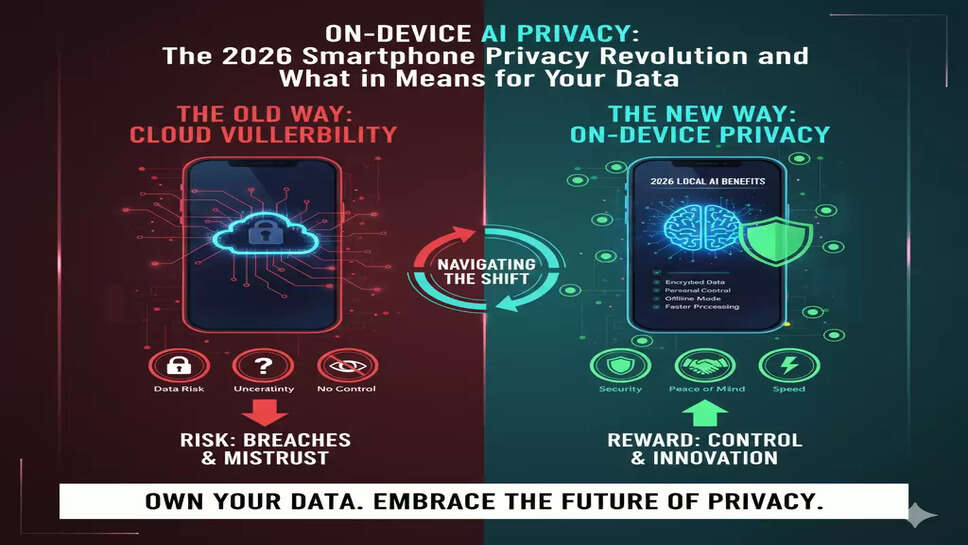
In early 2026, the "Cloud Tax"—the unspoken agreement where users trade their personal data for AI convenience—has finally been abolished. The 2026 smartphone market is defined by a massive pivot toward On-Device AI, a hardware-driven revolution that moves complex machine learning tasks from remote data centers directly onto the silicon in your pocket. While 2024 and 2025 were the years of the "Cloud Chatbot," 2026 is the year of the Local Brain. With the release of flagship processors like the Snapdragon 8 Gen 5 and Apple’s A19 Pro, smartphones now possess the teraflops of power necessary to run Small Language Models (SLMs) locally. For the consumer, this means that sensitive tasks—like summarizing a private legal document, translating a medical call, or generating a family photo—never require an internet connection or a data upload. In 2026, privacy is no longer a software setting; it is a physical characteristic of the hardware.
The Death of the "Wait" and the "Leak"
The primary benefit of On-Device AI in 2026 is the elimination of latency and the "Privacy Gap." Traditionally, when you asked an AI a question, your voice or text traveled to a server, was processed, and then sent back—a trip that took seconds and exposed your data to third-party interception. In 2026, smartphones process these requests in under 100 milliseconds.
-
Zero Latency: Features like Samsung’s "Live Call Translate" and Google’s "Magic Cue" now function instantly because the data doesn't leave the device.
-
Encryption by Default: Since the data never traverses a network, it is not vulnerable to "Man-in-the-Middle" attacks. Your 2026 device acts as a "Secure Enclave" where your emails, health records, and browsing habits are analyzed locally to provide personalized insights without ever reaching a corporate server.
The "Small Model" Breakthrough: SLMs vs. LLMs
The technical catalyst for the 2026 revolution is the rise of Small Language Models (SLMs). In 2024, it was believed that AI needed trillions of parameters to be useful. However, by January 2026, models like Meta’s Llama 3.2 3B and Google’s Gemini Nano 2 have proven that a compact 3-billion parameter model can handle 90% of daily tasks with human-level accuracy. These SLMs are "distilled" from their larger cloud-based siblings, retaining the logic while shedding the unnecessary weight. In 2026, your phone doesn't just predict the next word in a text; it understands the context of your entire calendar, your past preferences, and your real-time location to act as a proactive agent—all while residing entirely in your phone's RAM.
OBBBA Act: Supporting Data Sovereignty
The shift toward On-Device AI is also receiving a legislative tailwind from the One Big Beautiful Bill (OBBBA) Act. As of 2026, the OBBBA has introduced new "Data Sovereignty Credits" for tech manufacturers who implement hardware-level privacy protections.
-
Consumer Privacy Deduction: Under the OBBBA, consumers purchasing "High-Security AI Devices" (certified to process 100% of biometric and health data locally) can claim a $100 tax credit.
-
Infrastructure Relief: By moving AI processing to the "Edge" (the user's device), companies are reducing the massive energy and water demands on US data centers. The OBBBA incentivizes this shift to help the US meet its 2026 sustainability goals. This alignment of government policy and corporate engineering has made the 2026 smartphone the most secure personal computer ever created.
Agentic OS: The Invisible Assistant
In 2026, the operating system (OS) itself has become "Agentic." Instead of a static screen of apps, your 2026 smartphone uses on-device AI to reshape its interface based on your needs. If you are at the airport, your phone doesn't just show you a notification; its local agent has already analyzed your boarding pass, checked your proximity to the gate, and prepared a "Travel Dashboard" as your primary home screen. Because this "Scenario Awareness" is processed locally, the phone can "see" and "hear" your environment (with your permission) to provide help without creating a permanent digital log of your life in the cloud.
The Rise of Neuromorphic Computing
By mid-2026, premium smartphones have begun integrating Neuromorphic Chips—processors inspired by the human brain that only consume power when they detect a signal. These chips allow the AI to be "Always-On" but "Zero-Battery-Drain." For example, a 2026 phone can continuously monitor for signs of a car crash or a fall via its sensors, but it only "wakes up" the main processor when an event is detected. This makes 2026 devices significantly more efficient than their 2024 predecessors, extending battery life to a full 48 hours even with constant AI background processing.
Security-First Hardware: The Knox and Apple Intelligence Standard
Competition in 2026 is no longer about who has the best camera, but who has the most "Provable Privacy."
-
Apple iPhone 17 Pro Max: Uses the A19 Pro’s enhanced Neural Engine to ensure "Apple Intelligence" stays local. Any task too big for the phone is sent to "Private Cloud Compute," which uses silicon-level encryption that even Apple cannot break.
-
Samsung Galaxy S26 Ultra: Features "Knox Matrix," a decentralized security framework where your phone, watch, and tablet cross-authenticate each other locally to ensure no "Non-Human Identity" has infiltrated your personal network.
-
Google Pixel 10 Pro: Leverages the Tensor G5 chip to offer "Live Translation" in 13+ languages entirely offline, a feat that was considered impossible for a handheld device just three years ago.