
Neuromorphic Computing: Why Brain-Inspired Hardware is the 2026 Solution to the Energy Demands of Generative AI.
This article examines the 2026 transition from energy-hungry GPUs to neuromorphic chips, explaining how "spiking" neural networks and brain-inspired architectures are saving the generative AI revolution from an impending power crisis.
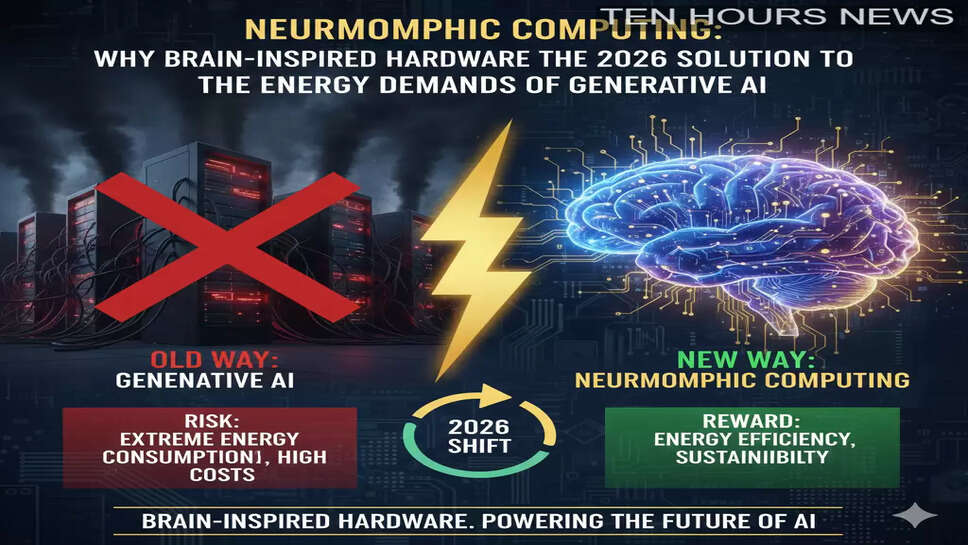
In early 2026, the global tech industry reached a tipping point. Generative AI, once a novel digital assistant, has integrated itself into every facet of the global economy—from autonomous urban transit to real-time scientific simulation. However, this progress came with a staggering cost. By late 2025, data center energy consumption had nearly doubled compared to 2023 levels, threatening national power grids and climate goals. The "brute force" era of AI, dominated by massive clusters of energy-intensive Graphics Processing Units (GPUs), has officially hit a physical and environmental wall. Enter neuromorphic computing: a paradigm shift in hardware design that mimics the biological efficiency of the human brain. In 2026, brain-inspired chips are no longer experimental curiosities; they have become the essential "Green AI" solution required to sustain the generative revolution.
The core of the problem lies in the traditional "von Neumann" architecture, which has governed computers for seventy years. In a standard GPU or CPU, the processing unit and the memory are physically separate. For every single calculation an AI performs, data must travel back and forth across a "bus," a journey that consumes significantly more energy than the computation itself. The human brain, by contrast, processes and stores information in the same place: the synapse. By replicating this architecture in silicon, neuromorphic chips are achieving up to a 1,000x reduction in power consumption for specific AI workloads. As we move through 2026, this technology is transitioning from research labs to the front lines of global infrastructure.
Breaking the Von Neumann Bottleneck
The defining characteristic of neuromorphic hardware in 2026 is its "event-driven" nature. Traditional AI chips operate like a metronome, burning power at every clock cycle regardless of whether the data being processed is important. They are essentially "always on." Neuromorphic chips, however, utilize Spiking Neural Networks (SNNs). These networks only consume power when a "spike" or signal occurs—much like a biological neuron firing only when it receives a specific stimulus.
This sparsity is the key to their efficiency. For a generative AI model running on a neuromorphic processor, the hardware remains dormant until a prompt is received or a specific data pattern is detected. In 2026, leading chips like Intel’s Loihi 2 and IBM’s NorthPole have demonstrated that they can run complex inference tasks—such as object recognition or natural language processing—using milliwatts instead of the hundreds of watts required by high-end GPUs. This allows powerful AI models to be embedded directly into battery-powered devices, from smartphones to remote environmental sensors, without needing a constant link to a power-hungry data center.
The 2026 Powerhouses: Loihi 2 and Hala Point
As of January 2026, Intel’s "Hala Point" system has become the gold standard for large-scale neuromorphic deployment. Packing over 1.15 billion artificial neurons into a chassis the size of a microwave, Hala Point consumes a mere 2,600 watts—less power than a high-end consumer oven—yet it can process AI tasks 20 times faster than the human brain. This system represents the first time neuromorphic hardware has been successfully scaled to support Large Language Models (LLMs) and complex generative architectures.
Unlike previous iterations, the 2026 generation of neuromorphic chips is built on advanced 3nm and 4nm process nodes, allowing for unprecedented density. These chips aren't just efficient; they are "learning-capable." While traditional GPUs are primarily used to "run" (infer) pre-trained models, neuromorphic hardware can perform "on-chip learning." This means an AI system can adapt to its environment in real-time—learning a user's specific voice patterns or a factory's unique mechanical vibrations—without ever sending data back to a central server. This local intelligence is the cornerstone of the 2026 privacy and security movement.
Sustainability and the "Net-Zero" AI Mandate
The adoption of neuromorphic computing is also being driven by aggressive new environmental regulations. In 2026, several major economies have introduced "AI Carbon Taxes," penalizing companies whose data centers exceed specific energy-per-inference thresholds. For many enterprises, switching to neuromorphic accelerators is no longer just a technical choice; it is a financial necessity.
By offloading the "inference" stage of generative AI to neuromorphic edge devices, companies are slashing their carbon footprints by up to 90%. This shift is particularly visible in the automotive industry. In January 2026, Mercedes-Benz and several other manufacturers began integrating neuromorphic vision processors into their autonomous driving suites. These chips allow the vehicle to "see" and react to its surroundings with ultra-low latency while consuming a fraction of the battery power, directly extending the driving range of electric vehicles (EVs).
Conclusion
The "Neuromorphic Spring" of 2026 marks the end of the energy-at-any-cost approach to artificial intelligence. By looking toward the 20-watt efficiency of the human brain, hardware engineers have found a way to decouple AI performance from massive power consumption. While GPUs will likely remain the workhorses for initial "brute force" training of trillion-parameter models, neuromorphic chips have claimed their territory as the primary engine for the "Everywhere AI" of the future. As we look toward the rest of 2026, the question is no longer whether we can afford the energy demands of AI, but how quickly we can transition our global infrastructure to the brain-inspired silicon that makes it sustainable.
FAQs
What is the main difference between a GPU and a neuromorphic chip? A GPU separates memory and processing (von Neumann architecture) and stays "on" constantly. A neuromorphic chip integrates memory and processing and only "fires" when there is a signal (event-driven), making it much more energy-efficient.
Why is neuromorphic computing gaining popularity in 2026? Because generative AI's energy demands have become unsustainable for data centers. Neuromorphic chips provide a 1,000x reduction in power for specific tasks, helping companies meet "net-zero" goals and avoid new carbon taxes.
Can neuromorphic chips run models like ChatGPT? Yes, 2026 systems like Intel's Hala Point have successfully demonstrated the ability to run Large Language Models (LLMs) and other generative architectures with massive efficiency gains.
What are "Spiking Neural Networks" (SNNs)? SNNs are a type of AI model that mimics biological neurons. They communicate via discrete electrical "spikes" rather than continuous data streams, which is why they consume so much less power.
Are neuromorphic chips available in consumer products? By January 2026, they have started appearing in high-end autonomous vehicles, advanced medical prosthetics, and specialized "Smart City" sensors, with a gradual rollout into flagship smartphones expected by late 2026.