
Neuralink Blindsight Human Trials: Understanding the 2026 FDA Rollout and the Ethics of Direct-to-Cortex Visual Restoration
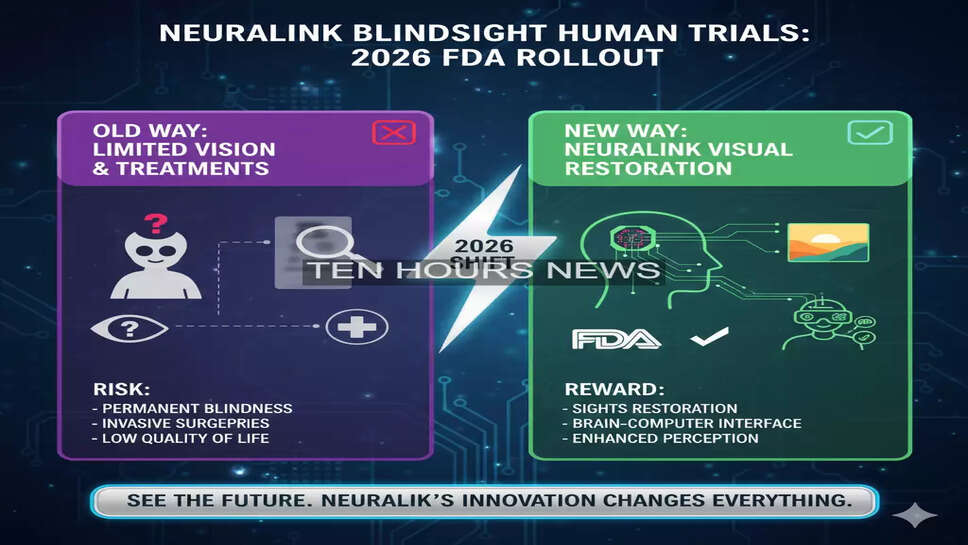
As of January 2026, Elon Musk's Neuralink has pivoted its focus toward the first human implantations of Blindsight, a brain-computer interface (BCI) designed to bypass damaged eyes and optic nerves entirely. Following the successful "PRIME" study for motor control in 2024 and 2025, the FDA’s "Breakthrough Device" designation granted in late 2024 has fast-tracked the regulatory path for visual restoration. In 2026, the company is preparing for high-volume production and streamlined, automated surgical procedures to begin the first clinical trials in humans, possibly in collaboration with international sites like the Cleveland Clinic Abu Dhabi.
How Blindsight Works: The Direct-to-Cortex Pathway
Unlike traditional retinal implants that require a functional optic nerve, Blindsight targets the Visual Cortex (V1).
-
Camera Input: The user wears a camera (likely mounted on glasses) that captures the environment and transmits data wirelessly to the implant.
-
Microelectrode Array: The "Link" chip, featuring approximately 3,000 electrodes across flexible threads, is surgically placed into the skull, with the threads penetrating the dura into the visual cortex.
-
Neural Stimulation: The chip stimulates specific neurons to create phosphenes—flashes of light that the brain interprets as visual patterns.
The "Atari" Resolution: Setting Realistic 2026 Expectations
The neurobiological reality of 2026 remains a significant hurdle. While Musk has claimed the device could eventually provide "superhuman" sight (infrared, ultraviolet, and radar), initial human trials are expected to produce much lower fidelity.
| Feature | Early 2026 Expectations | Neuralink Long-Term Goal |
| Resolution | Low-res "Atari" graphics (basic shapes/contrasts). | Surpassing natural human vision (4K equivalent). |
| Color Perception | Primarily monochromatic or grayscale. | Full spectrum + non-visible wavelengths (Infrared/UV). |
| Visual Complexity | Blurry outlines and silhouettes. | Sharp, detailed, and high-speed motion tracking. |
The 2026 Ethical Debate: Direct-to-Cortex Risks
The move from motor control to sensory restoration in 2026 has reignited critical bioethical questions.
-
The "Non-Visual" Brain: Experts argue that people blind from birth may not have developed the necessary neural pathways in the visual cortex to interpret electrical signals as "vision," raising concerns about the efficacy of treating congenital blindness.
-
Invasive Complications: Early motor trials (Noland Arbaugh) saw issues with thread retraction due to brain motion. In 2026, Neuralink has introduced new surgical measures and automated robots to minimize this risk during the delicate cortical implantation.
-
Identity and Autonomy: The integration of AI-processed camera feeds directly into the brain's sensory centers raises questions about "authentic" experience and the potential for digital manipulation of a user's perception of reality.
Conclusion
Neuralink's 2026 rollout of Blindsight represents a profound leap in neurotechnology, shifting from "reading" brain signals to "writing" sensory data. While the FDA's accelerated path has cleared the way for the first human trials, the scientific community remains cautious about the gap between media hype and clinical reality. For the patients enrolled in the 2026 trials, the goal is not yet superhuman vision, but the revolutionary ability to perceive basic shapes and regain spatial independence.
FAQs
Can Blindsight help people born blind?
Elon Musk claims that as long as the visual cortex is intact, the device can help those blind from birth. However, many neuroscientists remain skeptical, as the brain typically "repurposes" the visual cortex for other senses if it is never used for sight.
What is the surgical risk in 2026?
The surgery involves a robot drilling a hole in the skull and inserting threads into the brain. While Neuralink is moving toward a "streamlined, almost entirely automated" procedure in 2026, risks include infection, brain motion causing thread retraction, and tissue scarring.
Does Blindsight use a camera?
Yes. Since the device is designed for people who may have no eyes at all, it relies on an external camera (likely on glasses) to feed visual data to the chip.
What is the "Breakthrough Device" designation?
It is an FDA status that speeds up the development and review of medical devices that treat life-threatening or irreversibly debilitating conditions, providing the company with prioritized feedback.
When will Blindsight be commercially available?
There is no fixed date. In 2026, the technology is entering human clinical trials, a process that typically takes several years of rigorous testing before general public availability.