
Liquid Infrastructure: How Underwater Cooling is Saving Big Tech from the 2026 Emissions Cliff
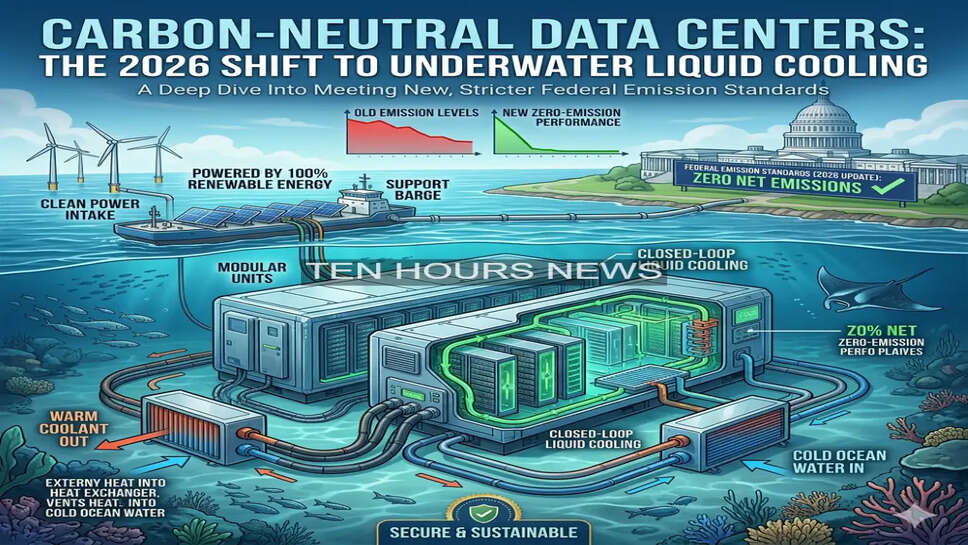
The data center industry has reached a thermodynamic crossroads in 2026. With global electricity consumption for AI and cloud computing hitting record levels this year, the "energy-for-compute" trade-off is no longer sustainable on land. Stricter federal emission standards—including new US transparency mandates and global efficiency benchmarks—are effectively penalizing air-cooled facilities for high Power Usage Effectiveness (PUE) scores. In response, Big Tech is plunging into Underwater Liquid Cooling, turning the ocean’s natural thermal mass into the ultimate carbon-neutral heat sink.
The shift is driven by the sheer physics of high-density AI. Modern server racks now exceed the cooling capacity of traditional air conditioning without massive energy waste. By submerging data pods in coastal waters, operators are achieving PUE ratios as low as 1.07. This isn't just about saving electricity; it is a mechanical necessity for meeting the Net-Zero reporting requirements that became law in early 2026. Facilities that fail to transition are facing inefficiency taxes and restricted access to the grid, making the seafloor the most viable real estate for the next generation of AI.
The Mechanics of Subsea Cooling
2026 underwater deployments are moving past the experimental phase into commercial scaling through three primary innovations:
-
Passive Heat Dissipation: Unlike land-based centers that use energy-intensive chillers, underwater pods use the surrounding seawater to naturally absorb heat through a rack-level split cooling system. This eliminates 30% to 40% of the total power budget typically spent on cooling.
-
Waste Heat Circularity: New 2026 pilot projects are using the low-grade waste heat from these pods to power Direct Air Capture (DAC) systems. This allows a data center to move from "Carbon Neutral" to "Carbon Negative" by actively removing CO2 using its own thermal byproduct.
-
The Pressure-Chamber Reliability: Data from 2026 deployments shows that servers in nitrogen-filled, underwater pods have a failure rate significantly lower than land-based units. The lack of oxygen, moisture, and human interference creates an ultra-stable environment that extends hardware life.
2026 Cooling Standards: Land vs. Underwater
| Feature | Traditional Air-Cooled (Legacy) | 2026 Underwater Liquid Cooling |
| Typical PUE Ratio | 1.55 – 1.60 | 1.07 – 1.12 |
| Cooling Energy Use | 35% of Total Power. | < 5% of Total Power. |
| Water Consumption | Millions of Gallons. | Zero Consumption. |
| Hardware Failure Rate | High (Oxidation/Dust). | Ultra-Low (Inert Atmosphere). |
| Federal Compliance | Risk of "Inefficiency Fines." | "Gold Standard" Certification. |
The "Thermal Debt" Controversy
As Big Tech dives deeper, a new environmental debate is heating up regarding Deep-Sea Thermal Debt. While these centers help meet carbon-neutral goals on paper, the continuous discharge of energy into coastal waters is raising concerns about localized marine warming.
Researchers are closely monitoring 2026 deployments to see if a temperature rise at the outlet disrupts local biodiversity or creates dead zones for sensitive species. Furthermore, by moving the environmental burden to the ocean, tech giants are meeting federal land-based emission targets, but critics argue this is simply shifting the environmental bill from the atmosphere to the hydrosphere.
Conclusion
The move to Underwater Liquid Cooling in 2026 is a bold strategy to align with the new reality of federal climate laws. By leveraging the ocean's natural cooling properties, the industry is managing to keep the AI revolution alive without collapsing the power grid. However, as thousands of pods are lowered into the sea, the question remains: can we solve the atmospheric carbon crisis without creating a deep-sea thermal one? In 2026, the data center is no longer a building; it is a marine ecosystem, and its survival depends on mastering the delicate balance between high-speed compute and environmental stewardship.
FAQs
Why are data centers moving underwater in 2026?
To meet stricter federal emission standards and handle the extreme heat of AI server racks more efficiently than traditional air cooling.
Does underwater cooling use a lot of energy?
No. It uses the natural temperature of seawater to absorb heat, reducing cooling energy costs by up to 95% compared to land-based systems.
Is it safe for the ocean?
While tech companies claim the impact is negligible, scientists are studying "thermal debt" to ensure the heat discharge doesn't harm marine life.
How do you fix a server underwater?
Most 2026 pods are designed to be maintenance-free for up to five years. If a major failure occurs, the entire pressure vessel is lifted to the surface for repair.
What is PUE?
Power Usage Effectiveness. It measures how much energy goes to the servers versus the cooling and lighting. A PUE of 1.0 is the "perfect" score.
Who is leading this technology?
Major hyperscalers and specialist firms are currently operating commercial-scale underwater facilities globally in 2026.