
DeepFleet: The Physical AI Revolution & the Rise of Embodied Intelligence
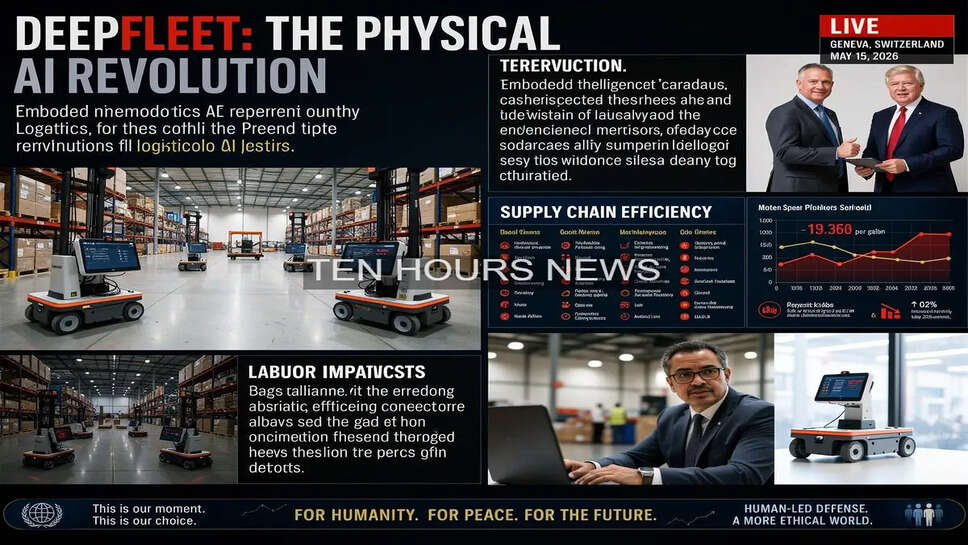
The milestone reached this May—Amazon’s millionth robot deployment—has signaled more than just an automation achievement; it has marked the formal beginning of the DeepFleet era. In 2026, the conversation has moved beyond digital "chatbots" to Embodied Intelligence (EI). Unlike traditional automation that follows rigid scripts, DeepFleet systems represent a physical AI revolution where machines possess the spatial reasoning and fine motor skills to navigate and manipulate the physical world with human-like dexterity.
Supply chain experts now view the warehouse not as a storage space, but as a "living" neural network. By 2026, the integration of multi-modal large language models into robotic frames has allowed for Zero-Shot Learning, where a robot can be shown a new task—like sorting a complex, non-standard medical kit—and execute it immediately without thousands of hours of manual programming.
The Three Pillars of the 2026 DeepFleet
-
Spatial Reasoning & Navigation: 2026 robots utilize Foundation Models for Robotics to understand geometry and intent. If a human worker drops an item, a DeepFleet agent doesn't just stop; it predicts the trajectory, safely navigates around the mess, and autonomously re-routes its fellow bots to maintain flow.
-
Dexterous Manipulation: The "holy grail" of robotics—picking soft, irregular, or fragile objects—has been solved via Tactile AI. Sensors in the robotic "fingers" provide a feedback loop that allows the AI to "feel" the pressure required to hold a glass vial versus a cardboard box.
-
Swarm Intelligence (Multi-Agent Orchestration): No robot operates in isolation. DeepFleet systems function as a singular, distributed brain. When one robot identifies a bottleneck at a loading dock, the entire fleet recalibrates their speeds and paths to alleviate the pressure in real-time.
Transformation Metrics: 2026 Supply Chain Impact
| Metric | Pre-DeepFleet (2023) | Embodied AI Era (2026) |
| Order-to-Delivery Time | 24–48 Hours (Standard). | 2–4 Hours (In-City/Micro-fulfillment). |
| Warehouse Energy Use | High (HVAC/Lighting for humans). | Low (Dark Warehouses/Optimized charging). |
| Safety Incident Rate | 3.5 per 100 workers. | <0.5 (Human-Robot collaborative zones). |
| Learning Speed | Months of programming. | Instant (Zero-Shot/Transfer Learning). |
| Operational Hours | 16/7 (With shifts). | 24/7/365 (Autonomous Maintenance). |
The Socio-Economic Shift
As Amazon and other logistics giants scale their physical AI fleets, the global workforce is undergoing a "Human-in-the-Loop" transition. The 2026 warehouse worker has largely evolved into a Fleet Supervisor or Edge Technician.
Experts argue that this shift is the only way to sustain the global demand for "instant commerce" amidst aging populations and labor shortages in the logistics sector. However, the 2026 debate remains focused on Data Sovereignty: as these robots "see" and "map" the interior of every major facility, the physical layout of a nation's supply chain becomes highly sensitive proprietary data.
Conclusion
DeepFleet: The Physical AI Revolution is the natural evolution of the intelligence age. In 2026, we are finally seeing AI "come out of the screen" and enter the physical world. Amazon’s million-robot milestone is just the blueprint. As embodied intelligence matures, the global supply chain will become faster, safer, and almost entirely invisible to the end consumer—a seamless, autonomous machine that never stops moving.
FAQs
What is "Embodied Intelligence"?
It is AI that has a physical body (a robot) and can perceive, move, and interact with the physical world, using spatial reasoning rather than just processing text or images.
What does "DeepFleet" refer to?
DeepFleet is a 2026 term for massive, interconnected swarms of autonomous robots that work together as a single unit to manage entire logistics ecosystems.
How do these robots learn new tasks so quickly?
They use "Foundation Models" similar to the tech behind ChatGPT, but for physical movement. This allows them to learn by watching a human or a video, a process called "Zero-Shot" or "Imitation Learning."
Are warehouses becoming fully "dark"?
Many micro-fulfillment centers are. "Dark warehouses" are facilities designed to run without lights or HVAC for humans, as the robots can operate perfectly in the dark and in varying temperatures.
How has safety changed with a million robots?
Safety has actually improved. In 2026, "Collaborative Robots" (Cobots) use advanced vision and proximity sensors to ensure they never make forceful contact with humans, creating a far safer environment than traditional heavy machinery zones.
Can these robots handle fragile items?
Yes. Breakthroughs in "Soft Robotics" and tactile sensors allow 2026 robots to handle items as delicate as a single egg or a ripe fruit without causing damage.