
Beyond Chatbots: How "Agentic AI" is Automating US Small Business Operations in 2026
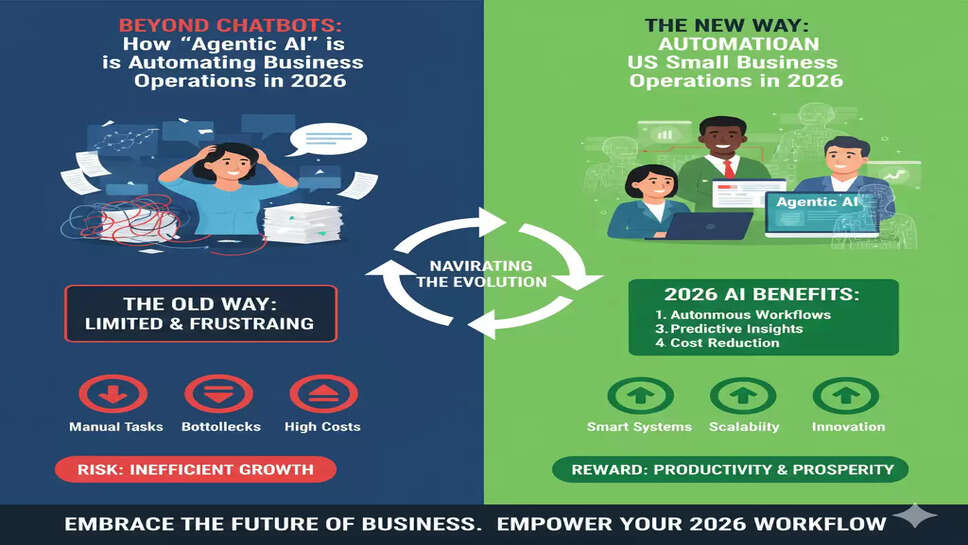
In 2026, the era of the "Reactive Chatbot" has officially ended for the American small business sector. While 2024 and 2025 focused on AI as a conversational interface, 2026 is defined by Agentic AI—autonomous systems capable of reasoning, planning, and executing complex multi-step workflows without constant human prompts. For a boutique retailer in Nashville or a family-owned HVAC company in Phoenix, AI is no longer just a tool for drafting emails; it has become a "Digital Teammate." These agents don't just answer questions; they manage inventory, negotiate with suppliers, and resolve customer service claims from end to end. According to recent data, early adopters of agentic systems are seeing a 30% to 50% acceleration in business processes, allowing small teams to achieve the operational scale of much larger corporations.
The Shift from "Chat" to "Action"
The fundamental brakthrough in 2026 is the transition from Large Language Models (LLMs) to Large Action Models (LAMs). Unlike a traditional chatbot that waits for a command, an AI agent in 2026 understands a broad objective—such as "optimize our supply chain for the upcoming holiday rush"—and breaks it down into sub-tasks. It can autonomously analyze sales trends, identify a potential shortage in raw materials, research alternative vendors, and draft a purchase order for approval. This "Proactive Intelligence" allows small business owners to move away from micromanaging daily tasks and toward high-level strategic oversight. In 2026, the measure of a successful AI is no longer how well it talks, but how much it does.
OBBBA Act: Funding the "Agentic Revolution"
The rapid adoption of agentic AI among US small businesses is being turbocharged by the One Big Beautiful Bill (OBBBA) Act. Recognizing that AI is now "Essential Infrastructure," the OBBBA has introduced a series of permanent tax incentives specifically for AI integration:
-
100% Bonus Depreciation: Small businesses can now fully expense the cost of AI hardware and "Agentic Infrastructure" (such as local NPU servers) in the first year.
-
Domestic R&E Repeal: The OBBBA permanently repealed the mandatory amortization of R&E expenditures, allowing startups and SMBs to deduct the full cost of developing custom AI agents immediately.
- 1099 Reporting Threshold: By raising the Form 1099 reporting threshold from $600 to $2,000 for payments made after December 31, 2025, the OBBBA has drastically reduced the administrative burden for small businesses hiring freelance "AI Orchestrators" to set up these autonomous systems.
Autonomous Supply Chain Orchestration
Supply chain management has become one of the most impactful use cases for agentic AI in 2026. Small manufacturers are now deploying "Orchestration Agents" that monitor global shipping trends and supplier performance in real-time. If a localized storm in a manufacturing hub is detected, the AI agent can autonomously reroute shipments or trigger a procurement flow from a secondary vendor. This level of responsiveness was previously only available to Fortune 500 companies with massive logistics departments. In 2026, a small business with just five employees can maintain a global, resilient supply chain that automatically adjusts to market disruptions, ensuring that shelf-stock remains consistent and costs stay low.
Customer Experience: The "Zero-Touch" Resolution
Customer support in 2026 has evolved into "Autonomous Case Management." When a customer contacts a small business regarding a refund or a shipping error, an AI agent doesn't just provide a canned response; it accesses the CRM, validates the purchase history, checks the warehouse logs, and issues the refund or replacement—all within seconds. This "Zero-Touch" resolution has increased Net Promoter Scores (NPS) for participating SMBs by an average of 15 points. By handling high-volume, routine requests end to end, agentic AI frees up human staff to focus on complex, high-empathy interactions that build long-term brand loyalty.
Finance and Risk: The Autonomous Auditor
Small business finance has been revolutionized by "Agentic Accounting." In 2026, AI agents act as continuous, real-time auditors. They scan millions of transactions per millisecond to spot odd patterns, detect potential fraud, and automatically freeze compromised accounts before a single dollar is lost. Furthermore, these agents can manage "Predictive Cash Flow," moving funds between accounts to optimize interest earnings or forecasting tax liabilities weeks in advance. Under the OBBBA's new EBITDA-based interest deduction rules, these agents are helping small businesses maximize their interest expense deductions, ensuring that every financial move is optimized for the 2026 tax code.
The Rise of the "SuperWorker"
The integration of agentic AI is creating a new class of employee known as the "SuperWorker" or "Augmented Worker." These are individuals who have been trained to oversee a "fleet" of AI agents. Instead of performing data entry or scheduling, the 2026 employee spends their day "Orchestrating"—setting goals for the agents, reviewing high-value exceptions (such as refunds over $500), and refining the agents' internal logic. This shift is redefining workforce strategies, with small businesses prioritizing "AI Literacy" as the most critical skill for new hires. The OBBBA Act supports this transition through enhanced Employer-Provided Childcare Credits and student loan assistance, making it easier for businesses to attract the top-tier talent needed to manage an autonomous office.
Conclusion
As we look toward the remainder of 2026, the message for US small businesses is clear: the future belongs to those who deploy agents, not just chatbots. The combination of Agentic AI’s autonomous capabilities and the OBBBA Act’s aggressive tax incentives has created a unique window of opportunity for SMBs to compete on a global scale. By delegating routine operations to digital teammates, small business owners are reclaiming their most valuable asset—time. In 2026, your business isn't just powered by AI; it is orchestrated by it. The "Chatbot Era" was just the beginning; the "Agentic Era" is where the real work—and the real growth—happens.
FAQs
What is the main difference between a chatbot and an AI agent?
A chatbot is reactive and waits for a specific prompt to provide information. An AI agent is proactive; it can set its own goals, use external tools (like your bank or CRM), and execute multi-step tasks autonomously.
How does the OBBBA Act help me afford AI for my business?
The OBBBA Act allows for 100% bonus depreciation on AI-related hardware and software, meaning you can deduct the entire cost from your taxes in the same year you buy it. It also simplifies reporting for the consultants who help you set it up.
Can AI agents handle my business's banking and payments?
Yes. In 2026, AI agents are commonly used to automate invoice processing, detect fraudulent transactions, and manage cash flow across different business accounts with minimal human supervision.
Will AI agents replace my small business employees?
Rather than replacing employees, AI agents are creating "SuperWorkers." These agents handle the "low-value" repetitive tasks, allowing your human staff to focus on high-value strategy, creativity, and customer relationships.
Do I need to be a tech expert to use agentic AI?
No. Most 2026 agentic platforms use natural language instructions. You can describe your business goals in plain English, and the agent will connect to your existing systems to execute the work.