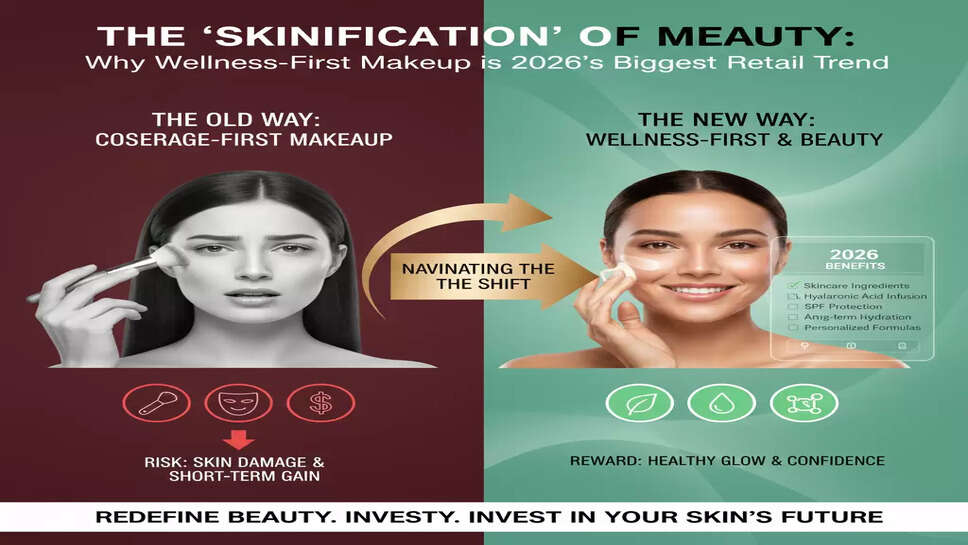
In the landscape of American retail in 2026, the traditional distinction between "skincare" and "color cosmetics" has effectively vanished. What began as a niche interest in "no-makeup makeup" earlier this decade has evolved into a multi-billion-dollar industry shift known as the "Skinification" of Beauty. Today, consumers no longer view foundation, blush, or even mascara as mere pigments to mask imperfections. Instead, they demand that every item in their vanity serves as a high-performance extension of their morning serum routine. This "Wellness-First" mandate is driving the most significant retail reorganization in decades, with mass-market giants like Walmart and Target following the lead of prestige boutiques to prioritize clinical efficacy over sheer coverage. As we navigate the first quarter of 2026, the beauty counter is no longer just a place for aesthetic transformation; it has become a primary touchpoint for metabolic health and proactive dermatological care.
The Evolution of Hybrid Formulas and "Active Makeup"
The defining characteristic of 2026 beauty is the inclusion of "biologically active" ingredients in color cosmetics that were previously reserved for luxury night creams. In 2024, seeing hyaluronic acid in a tinted moisturizer was a selling point; in 2026, it is a baseline expectation. The industry has moved toward "Large Action Formulas"—makeup that actively repairs the skin barrier while the user wears it throughout the workday. One of the breakout ingredients of 2026 is PDRN (Polydeoxyribonucleotide), often derived from biotechnologically engineered sources or, in prestige lines, from salmon-based regenerative science. This ingredient, which was a viral K-beauty secret in late 2025, is now infused into 2026's top-selling serum foundations to stimulate collagen production and reduce cellular inflammation. Alongside PDRN, we see a surge in "climate-adaptive" ingredients like astaxanthin and bakuchiol in blushes and bronzers. These multifunctional antioxidants protect against the increased digital blue light exposure and urban environmental stressors that define modern life. For the 2026 consumer, applying makeup is the final step of a regenerative medical protocol, ensuring that the skin is "working" to heal itself even under a layer of radiant pigment.
Retail Reorganization: From Aisles to "Ecosystems"
Retailers in 2026 have responded to this trend by completely redesigning their floor plans. The old "drugstore" wall of plastic-wrapped lipsticks is being replaced by "Beauty-Health Ecosystems." These sections are curated not by brand or product type, but by "Skin State" or "Metabolic Goal." Walking into a high-end retail space in 2026, you will find sections titled "Barrier Recovery," "Cortisol-Control Glow," and "Hormone-Sync Complexions." This shift mirrors the broader 2026 trend of Metabolic Beauty, where products are sold as solutions for internal physiological shifts. Sephora, for example, has expanded its "Clean at Sephora" initiative into a comprehensive "Proactive Health" certification, requiring brands to prove that their pigments do not contain endocrine disruptors or microplastics. This "Democratization of Efficacy" means that even at an affordable price point, shoppers can find peptide-infused concealers that offer the same clinical benefits as products that cost three times as much just two years ago. The retail success of 2026 belongs to the "Well-Care Partner"—the brand that can explain exactly how its lipstick nourishes the delicate lip microbiome while providing twelve hours of vibrant color.
The Tech Edge: AI-Driven Precision and Personalization
The skinification trend is being hyper-accelerated by the Agentic AI revolution currently sweeping US small businesses and retail. In 2026, "blind-buying" a foundation shade is a relic of the past. Almost every major beauty retailer now features high-compute, on-device AI mirrors and smartphone apps that analyze a user’s skin biomarkers in real-time. These tools do more than just match a color; they assess hydration levels, pore congestion, and even early signs of UV damage to recommend a custom-blended "Complexion Treatment." By early 2026, several flagship stores in New York and Los Angeles have introduced on-site "Micro-Compounding Stations." Here, an AI agent takes your skin scan data and instructs a robotic dispenser to mix a foundation that contains the exact ratio of niacinamide and SPF your skin requires for that specific week’s weather forecast. This level of "Algorithmic Authenticity" ensures that the makeup is not just sitting on top of the skin but is optimized to support its specific, localized needs. In 2026, personalization is the ultimate luxury, and tech is the invisible hand making it accessible to the masses.
The OBBBA Act and the Economics of Beauty
The financial backbone of this wellness shift is supported by the One Big Beautiful Bill (OBBBA) Act, which has redefined how biotech-led beauty companies operate in the United States. Under the OBBBA’s 2026 tax framework, companies that focus on "Domestic Bio-Manufacturing" for skincare and wellness ingredients receive significant research and development credits. This has led to a "Sourcing Renaissance" where US-based startups are producing sustainable, lab-grown botanicals that are more stable and potent than traditional extracts. Furthermore, the OBBBA's Bonus Depreciation rules have allowed small, independent beauty retailers to invest in the expensive AI skin-scanning hardware and refrigeration units needed for "Prescription-Grade" clean makeup. The bill has also influenced consumer behavior through Wellness Savings Incentives, where certain high-SPF or barrier-repairing makeup products are increasingly being recognized as "Preventative Health Tools." This makes them eligible for purchase using tax-advantaged accounts in some corporate wellness structures. In 2026, the government isn't just watching the beauty industry; it is incentivizing its transformation into a vital branch of the American public health sector.
The "Fauxzempic" Effect and Sculpting Solutions
A fascinating sub-trend within the 2026 skinification movement is the rise of "Fauxzempic" makeup. As the 2026 Medicare GLP-1 expansion has made weight-loss medications more accessible, millions of Americans are dealing with the associated "Ozempic Face"—a loss of facial volume and skin elasticity. In response, the 2026 makeup market is flooded with "Volumizing Pigments" and "Sculpting Serums" designed to mimic the structural support of healthy fat pads. These products use advanced peptides and "lifting" polymers to create a temporary but visible tightening effect. Unlike the heavy contouring of 2016, the 2026 "Sculpt" is about restoring a youthful, healthy fullness to the cheeks and jawline through light-reflective technology and deep-tissue hydration. This reflects the 2026 consumer’s desire for "Biology-Informed Aesthetics"—where the makeup doesn't just look like a mask, but works as a structural intervention to provide a rested, vitalized appearance.
Conclusion
The "Skinification" of beauty in 2026 is far more than a marketing buzzword; it is a fundamental reimagining of what it means to "get ready" in the morning. By prioritizing Wellness-First formulations, the retail industry has moved away from the superficiality of the past and toward a future where beauty and health are synonymous. Supported by the technological breakthroughs of Agentic AI and the legislative tailwinds of the OBBBA Act, the makeup products of 2026 are active participants in our longevity and self-care routines. For the consumer, this trend offers a new level of "Digital Sovereignty" over their own biology, allowing them to choose products that protect, heal, and enhance simultaneously. As we look toward the future, the message from the 2026 retail shelves is clear: the most beautiful thing you can wear is your own skin, optimally supported by the best that science and wellness have to offer.
FAQs
What does "Skinification" mean in the 2026 beauty market?
Skinification refers to the trend of infusing traditional color cosmetics—like foundation, lipstick, and mascara—with high-performance skincare ingredients like peptides, PDRN, and antioxidants. It treats makeup as an extension of a skincare routine.
Why is AI so important for makeup shopping in 2026?
AI mirrors and smartphone apps allow for real-time biomarker analysis, enabling retailers to offer personalized complexion products that match not only your skin tone but also your current hydration and sensitivity levels.
Does the OBBBA Act impact the price of my makeup?
Indirectly, yes. The OBBBA Act provides tax credits for domestic bio-manufacturing and R&D, which has helped stabilize the cost of high-tech, "active" ingredients and encouraged small businesses to adopt advanced retail technologies.
Are "Fauxzempic" products only for people on weight-loss drugs?
No. While inspired by the facial volume loss seen with GLP-1 medications, these "sculpting" and "volumizing" products are popular with anyone looking for a lifted, firm, and youthful appearance without undergoing surgical procedures.
How can I tell if a product is "Wellness-First"?
In 2026, look for transparency markers such as "Endocrine Disruptor Free," specific lists of bio-active percentages, and certifications from retail-led health initiatives that prioritize long-term skin barrier health.