
"Salvaged Stays": Why Upcycled Retreats are Outpacing Traditional Luxury Hotels in 2026
Explore the 2026 trend of "Salvaged Stays." Learn why upcycled hotels like repurposed banks and prisons are outperforming traditional luxury in the OBBB Act era.
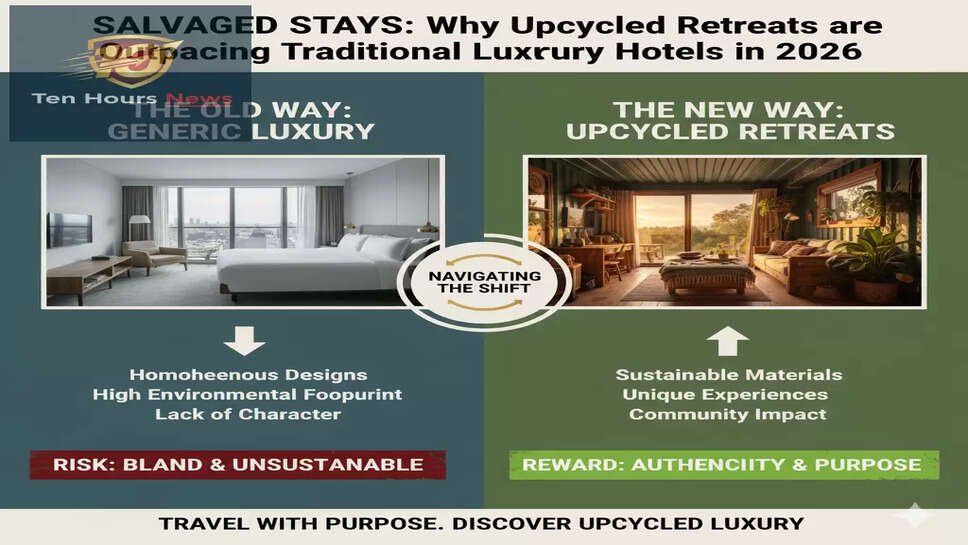
The travel landscape of 2026 is defined by a paradox: the more high-tech our "Silicon Workforce" becomes, the more travelers crave the "texture" of the past. This has given rise to the Salvaged Stays movement, a trend where upcycled retreats—historic buildings repurposed into upscale hotels—are now outpacing traditional purpose-built luxury hotels in both search volume and occupancy rates. According to the Expedia Group "Unpack ’26" report, travelers are no longer satisfied with the "sterile perfection" of modern glass-and-steel resorts. Instead, they are checking into former schoolhouses in Kyoto, converted prisons in Cornwall, and repurposed banks in Montreal. This shift is driven by a desire for "Architectural Authenticity" and is heavily supported by the One Big Beautiful Bill (OBBB) Act, which provides massive tax credits for "Adaptive Reuse" projects that revitalize urban centers and preserve cultural heritage. In 2026, luxury is no longer defined by the thread count of the sheets, but by the story embedded in the walls.
The Architecture of Authenticity: Beyond "Cookie-Cutter" Luxury
In 2026, the global traveler is suffering from "Brand Fatigue." Traditional luxury chains, while reliable, often offer the same aesthetic whether you are in Dubai or Des Moines. Salvaged Stays offer an antidote to this uniformity by preserving the "Soul" of a structure.
- Preserved Landmarks: Hotels like Nine Orchard in New York and Hotel Place d’Armes in Montreal have kept original bank vaults and ornate stone façades, allowing guests to sleep inside a piece of financial history.
- Unconventional Spaces: The trend extends to the truly unusual. The Bodmin Jail Hotel in the U.K. has transformed former prison cells into boutique suites, while the InterContinental Khao Yai in Thailand uses upcycled railroad carriages as luxury guestrooms.
- Storytelling as Amenity: In these properties, the "History Tour" is often more popular than the spa. Guests in 2026 want to know that they are dining in an old ticket counter (like at Union Station Nashville Yards) or swimming in a former mint.
The OBBB Act: Fueling the Adaptive Reuse Boom
The economic engine behind the Salvaged Stays movement is the OBBB Act’s Heritage Restoration Credit. Realizing that demolition is a major contributor to carbon emissions, the federal government in 2025 shifted its focus toward subsidizing the "upcycling" of the built environment.
- 12-15% Cost Savings: Studies from the World Economic Forum in 2025 showed that adaptive reuse can be up to 15% cheaper than new construction by avoiding demolition and foundation costs. The OBBB Act amplifies this by offering a 25% "Green Restoration" tax credit for developers who convert underutilized assets (like abandoned warehouses or schools) into eco-friendly lodging.
- 50-75% Carbon Reduction: The OBBBA mandates strict "Scope 3" carbon reporting for the hospitality sector starting in 2026. Because repurposing an existing building emits significantly less carbon than building new, developers are flocking to "Salvaged" projects to meet their mandatory ESG (Environmental, Social, and Governance) targets.
-
Urban Revitalization Grants: Many Salvaged Stays are located in "Opportunity Zones" designated by the OBBBA, where the conversion of a defunct factory into a boutique hotel can trigger millions in additional infrastructure grants for the surrounding community.
The "Silicon Orchestrator" and the Heritage Stay
The irony of 2026 is that these historic buildings are powered by the most advanced technology available. The "Salvaged" aesthetic is the "Shell," but the "System" is purely Agentic AI.
-
Invisible Tech: In a Salvaged Stay, you won't see a tablet on every desk. Instead, Agentic AI (Silicon Employees) operates behind the scenes, managing the building's thermal envelope and lighting to ensure that an 18th-century abbey operates with 21st-century energy efficiency.
-
Personalized Heritage Itineraries: Before a guest arrives, an autonomous agent analyzes their interests and "sculpts" a local tour. If you are staying in a former brewery, the agent might book a private tasting with a local maltster who still uses the building's original water source.
-
Seamless Handshake: The OBBBA-funded technology allows these older buildings to sync with a traveler’s "Digital Health Passport," automatically adjusting the room’s air filtration and humidity based on the guest’s real-time biometric needs.
Why 2026 Travelers Prefer "Rescued" Over "New"
The psychological shift toward Salvaged Stays is rooted in a post-pandemic re-evaluation of what constitutes "Real Value."
- Cultural Resonance: 2026 travelers, particularly Gen Z and Millennials, prioritize "Meaning over Materialism." They see staying in a repurposed school or bank as a way of "voting" for a more circular and sustainable economy.
- The "Unpack '26" Data: Searches for "Upcycled Hotels" and "Historic Converted Lodging" have surged by over 190% for destinations like Kyoto, where the Hotel Seiryu (a former school) has become the city's most sought-after address.
-
The "Hushpitality" Effect: Repurposed buildings, often built with thick stone or brick, offer a level of "Acoustic Luxury" that modern hotels find difficult to replicate. This "Hushpitality"—the luxury of absolute silence—is a primary selling point for the 2026 traveler looking to disconnect.
Challenges: The "Ghost in the Machine" and Maintenance Costs
While the trend is booming, Salvaged Stays face unique 2026 hurdles that traditional luxury hotels do not.
-
Structural Limitations: Converting a 19th-century prison into a 5-star hotel requires engineering feats that often push even OBBBA-subsidized budgets to their limits.
- The "Haunting" Factor: Properties like the Bodmin Jail Hotel must lean into their "Storied Past" carefully. In 2026, some travelers seek out "Ghost Tours," while others are put off by the dark history of former correctional facilities.
-
Data Privacy in Historic Walls: Under the 2026 CCPA Amendments, Salvaged Stays must be transparent about the AI sensors integrated into historic moldings. Providing a clear "Opt-Out Confirmation" for room-level monitoring is a legal requirement that older buildings find challenging to implement physically.
Conclusion
The rise of "Salvaged Stays" in 2026 marks the end of the "Bling Era" of luxury travel. Supported by the fiscal incentives of the OBBB Act and the efficiency of Agentic AI, these upcycled retreats are proving that the most luxurious thing a business can offer is a second life for a forgotten space. As we move closer to the Sestercentennial, the desire to connect with the "Real America" and "Real History" is driving travelers into the arms of these rescued relics. Traditional luxury hotels are now scrambling to retrofit their properties with "Heritage Elements," but they cannot easily manufacture the 100-year-old soul of a former train station or mint. In 2026, the hotel room of the future is, quite literally, a room from the past. Whether it’s a "Readaway" in an old library or a "Longevity Reset" in a former abbey, the message is clear: the walls have a story to tell, and the 2026 traveler is finally listening.
FAQs
What exactly is a "Salvaged Stay"?
A Salvaged Stay is a hotel or retreat housed in a repurposed historic building—such as a former bank, school, prison, or factory—that preserves the original architecture while providing modern luxury.
Why are these hotels suddenly more popular than new luxury resorts?
Travelers in 2026 are seeking "authenticity" and "storytelling" over cookie-cutter brand experiences. Additionally, these properties are more sustainable, often utilizing OBBB Act tax credits for adaptive reuse.
How does the OBBB Act support these types of hotels?
The OBBB Act provides "Heritage Restoration Credits" and "Green Transformation" subsidies, making it financially attractive for developers to upcycle old buildings rather than construct new ones.
Are upcycled hotels as comfortable as modern ones?
Yes. In 2026, "Agentic AI" (Silicon Employees) manages the internal climate and amenities of these historic shells, providing a high-tech experience inside a low-tech, authentic exterior.
Where are some of the top Salvaged Stays located?
Notable examples include Hotel Seiryu Kyoto Kiyomizu (Kyoto), Bodmin Jail Hotel (Cornwall), Union Station Nashville Yards (Tennessee), and Hôtel Place d'Armes (Montreal).