
Micro-Habitation Architecture: Why High-Density Modular Micro-Living is the 2026 Solution to Global Urban Housing Crises.
This article analyzes the 2026 breakthrough of micro-habitation architecture, exploring how modular, factory-built living units are solving the global housing shortage through rapid deployment, sustainability, and extreme spatial efficiency.
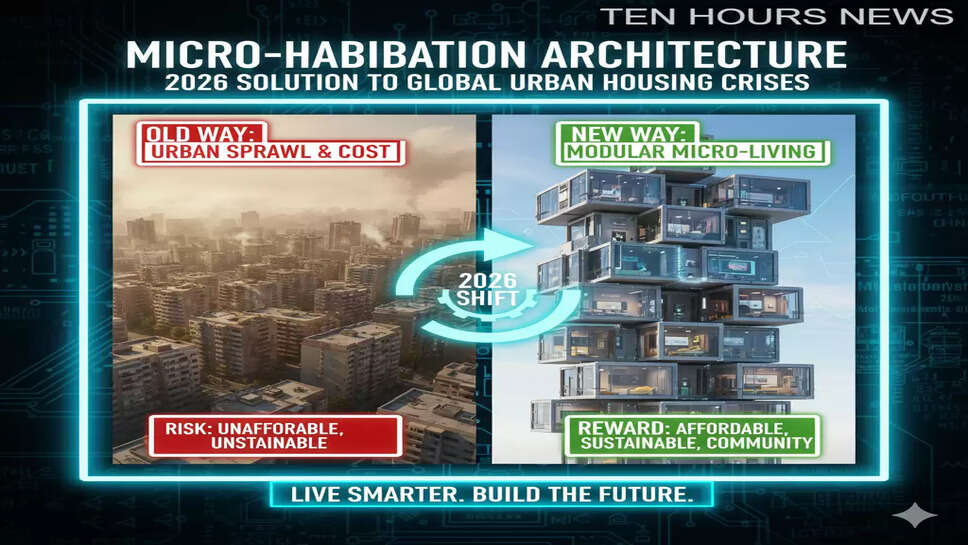
By January 2026, the global housing crisis has reached a historic inflection point. With nearly 2.8 billion people worldwide facing inadequate housing, traditional construction methods—slow, expensive, and resource-heavy—are no longer sufficient. In response, "Micro-Habitation Architecture" has emerged as the definitive solution for the mid-2020s. This movement prioritizes high-density, modular micro-living units that are manufactured in factories and "plugged into" urban grids. These units, often ranging from 15 to 30 square meters, are not just small apartments; they are highly engineered, tech-infused pods designed to maximize human dignity and sustainability in the world's most crowded megacities.
The success of micro-habitation in 2026 is driven by "Advanced Industrialization." Unlike the experimental modular projects of the previous decade, today’s systems are 90% factory-complete before they even reach the site. This shift allows for the construction of 50-story micro-living towers in a matter of weeks rather than years. By treating housing as a scalable, repeatable industrial product—similar to the automotive industry—cities from London to Mumbai are finally beginning to close the gap between housing supply and demand.
The Modular Advantage: Speed, Scalability, and Precision
The cornerstone of the 2026 housing strategy is the "Plug-and-Play" modular system. Each micro-unit is a self-contained structural box, complete with plumbing, electrical systems, and built-in smart furniture. These modules are transported to underutilized urban "infill" sites—such as former parking lots or gaps between existing buildings—and stacked using high-precision cranes. This method reduces on-site labor by 80% and slashes construction waste, as material use is optimized within the controlled environment of a factory.
Furthermore, the 2026 generation of modular units utilizes Cross-Laminated Timber (CLT) and recycled steel frames. These materials are not only sustainable but lightweight, allowing for higher vertical density without the massive carbon footprint of traditional concrete. In cities like Seoul and New York, "Micro-Clusters" are being deployed on rooftops and in industrial zones, creating vibrant, high-density communities that can be easily expanded or reconfigured as the city's needs change.
Inside the 2026 Micro-Unit: Spatial Magic and Smart Surfaces
Living in 25 square meters in 2026 does not feel restrictive, thanks to "Kinetic Interiors." The architectural logic of micro-habitation relies on multi-functional furniture that transforms throughout the day. A desk that folds into a queen-sized bed, "Cloud" storage systems that utilize ceiling space, and walls that slide to reveal hidden kitchenettes are now standard features. These units are designed with "Optimal Space" guides that prioritize natural light and high ceilings to create an illusion of openness.
Beyond the physical layout, 2026 micro-homes are "AI-Native." Integrated IoT systems manage energy use, lighting, and climate control, learning the resident's habits to minimize utility costs. "Reconfigurable Intelligent Surfaces" (RIS) are even being embedded into the walls to boost 6G signals, ensuring that these compact spaces are the most connected environments on earth. This tech-heavy approach makes micro-habitation especially appealing to the "Digital Nomad" and young professional demographic, who value proximity to urban centers and high-speed connectivity over square footage.
The Social Impact: From Isolation to Communal Living
Critics of micro-housing often point to the potential for social isolation. However, the 2026 model of micro-habitation architecture addresses this through "Layered Community Scales." Individual private units are small, but they are nested within larger buildings that feature expansive communal spaces. These include shared industrial-sized kitchens, rooftop hydroponic gardens, coworking lounges, and "Tool Libraries."
By shifting the focus from private ownership of space to shared access to amenities, micro-habitation is fostering a new type of urban social fabric. In Tokyo and Berlin, these projects have become hubs for "Collective Domesticity," where residents live privately but socialize and collaborate in high-quality shared environments. This model is proving to be a powerful tool for integrating migrant populations and young workers into the city, providing a sense of belonging that traditional, isolated apartments often lack.
Sustainability: The Net-Zero Urban Standard
From an environmental perspective, micro-habitation is the only path to meeting the 2026 "Net-Zero" mandates. Smaller units naturally require less energy to heat and cool, but the 2026 units go further. Many are equipped with "Aerothermal" heat pumps and transparent photovoltaic glass that generates electricity from the sun while acting as a window.
Embodied carbon—the CO2 emitted during the manufacturing of building materials—is also drastically lower in these units due to the use of biogenic materials like CLT. As cities face increasing pressure to reduce their environmental impact, micro-habitation provides a scalable blueprint for "Climate-Adaptive" urbanism. These buildings are designed for "Deconstruction and Reuse," meaning that at the end of their lifecycle, the modules can be disassembled and recycled rather than demolished into a landfill.
Conclusion
Micro-habitation architecture is more than just a trend; it is the fundamental restructuring of the urban home for the 21st century. In 2026, we have moved past the era of urban sprawl and toward a model of "Intelligent Density." By combining the efficiency of factory manufacturing with the flexibility of modular design and the intelligence of AI, micro-living is providing a dignified, sustainable, and affordable solution to the global housing crisis. As we look to the rest of 2026, the success of these first major pilots suggests that the future of the city is not bigger—it is smarter, smaller, and more connected.
FAQs
What is the average size of a micro-habitation unit in 2026? Units typically range from 15 to 30 square meters (approx. 160 to 320 sq ft). They are designed using "kinetic" furniture to make the space feel much larger than its actual footprint.
How long does it take to build a micro-habitation tower? Because the units are prefabricated in factories, a mid-rise building can often be assembled on-site in 4 to 8 weeks, compared to 18–24 months for traditional construction.
Are these units affordable for the average worker? Yes. The industrial scaling of production has lowered costs by 20–30% compared to traditional apartments, and the extreme energy efficiency leads to significantly lower monthly utility bills.
Can I move my micro-unit to a different building? While most are permanent, many 2026 modular systems are designed for "Circularity," meaning they can be detached and moved to a new site or building frame if urban planning needs change.
Is living in a micro-unit healthy for long-term residency? The 2026 standards focus heavily on "Biophilic Design," incorporating high ceilings, natural materials like wood, and shared green spaces to ensure mental well-being and air quality.