
Bio-Interactive "Smart" Fabrics: Why 2026 Sensor-Infused Clothing is Replacing Traditional Wrist-Based Health Wearables.
This article explores the 2026 shift from smartwatches to bio-interactive smart fabrics, detailing how integrated sensors in clothing are providing more accurate, non-invasive health data than traditional wrist-based wearables.
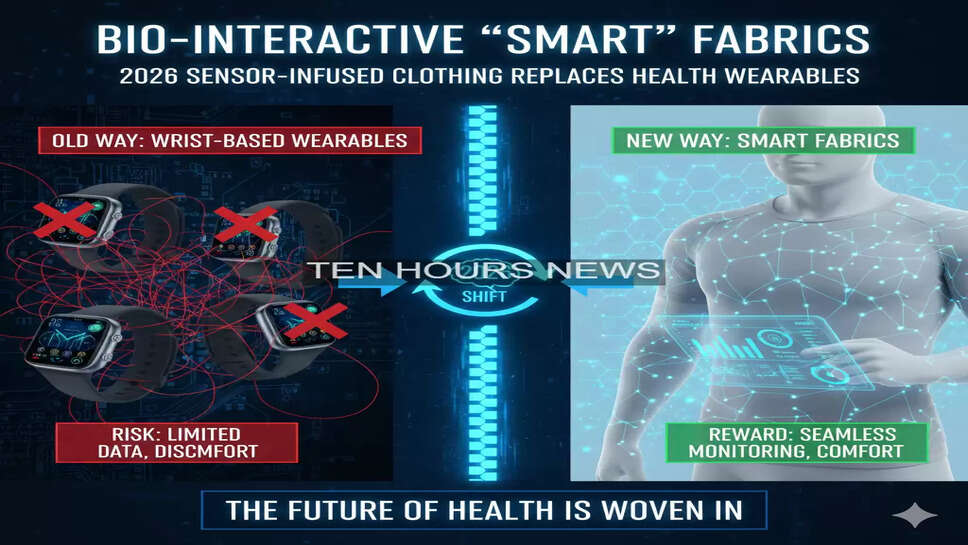
For over a decade, the smartwatch was the undisputed king of personal health tracking. From the first mainstream fitness bands to the advanced medical-grade watches of 2024, the wrist was the primary real estate for our digital health data. However, as we move through January 2026, a fundamental shift is occurring in the wearable market. The "wrist fatigue" caused by bulky devices and inconsistent sensor contact has led to the rise of Bio-Interactive Smart Fabrics. By weaving technology directly into the threads of our everyday garments, the industry is moving toward a future where our clothing doesn't just cover our bodies—it communicates with them. In 2026, your t-shirt is no longer just a piece of apparel; it is a sophisticated, multi-point diagnostic tool that makes traditional wearables look like relics of the past.
The transition to smart fabrics is driven by a simple biological truth: the wrist is one of the least efficient places to gather comprehensive biometric data. While convenient, wrist-based sensors struggle with movement artifacts, varying skin tones, and limited contact surface area. Bio-Interactive Smart Fabrics solve these issues by utilizing "Large-Area Sensing." Because a shirt or a pair of leggings covers a vast portion of the torso and limbs, it can host a network of distributed sensors that provide a 360-degree view of a user's physiology. This "Digital Skin" approach is the defining tech trend of 2026, offering a level of accuracy and comfort that wrist-based devices simply cannot match.
The Technology: Conductive Yarns and Molecular Sensors
The "Smart" in 2026 fabrics is no longer about bulky wires or detachable modules. The breakthrough lies in Conductive Yarns—fibers infused with graphene, silver, or liquid metals that behave exactly like traditional thread. These yarns are woven into specific patterns to create electrodes that measure Electrocardiogram (ECG) signals, Electromyography (EMG) for muscle activity, and Bioimpedance for hydration levels. Because these sensors are part of the fabric itself, they remain flush against the skin regardless of how the user moves, eliminating the "noise" that often plagues smartwatches during high-intensity exercise.
Furthermore, the 2026 generation of bio-interactive textiles has introduced Molecular Biosensors. These are specialized coatings on individual fibers that can analyze the chemical composition of the wearer's sweat. By monitoring pH levels, lactate thresholds, and even glucose concentrations in real-time, these fabrics provide a biochemical profile that was previously only available through blood tests. For athletes and chronic disease patients alike, this means the garment they wear to bed or to the gym is providing a continuous stream of clinical-grade data without the need for a single needle or a glowing wrist display.
The Death of the Charging Cable: Energy-Harvesting Textiles
One of the primary reasons health-conscious consumers are abandoning smartwatches in 2026 is "Charging Anxiety." Even the most advanced watches of the mid-2020s required frequent visits to a charging puck. Bio-interactive fabrics are bypassing this limitation through Energy-Harvesting Micro-Grids. By utilizing "Triboelectric" and "Thermoelectric" effects, these garments convert the wearer’s kinetic movement and body heat into electricity.
In the January 2026 launch of the latest "Solar-Thread" collections, we are seeing shirts that can power their own heart-rate sensors and Bluetooth Low Energy (BLE) transmitters indefinitely just by being worn during a morning walk. This self-powering capability removes the final hurdle to 24/7 health monitoring. When your health tracker is your clothing, and your clothing never needs to be plugged in, the data loop becomes truly seamless. This has led to a 40% drop in smartwatch renewals in early 2026, as users opt for "Sensor-Sleeves" and "Biometric Baselayers" that integrate into their existing wardrobes.
From Fitness Tracking to Predictive Healthcare
While 5G and early 6G pilots are providing the connectivity, AI-Driven Predictive Analytics are the "brain" behind these fabrics. In 2026, smart clothing doesn't just tell you how many steps you took; it tells you that you are likely to experience a respiratory infection in the next 48 hours. By analyzing subtle changes in skin temperature, breathing patterns, and heart rate variability across the entire torso, these fabrics can detect the early physiological signatures of illness or overtraining long before the user feels symptoms.
This has profound implications for the elderly and those with chronic conditions. "Smart Undergarments" have become a standard recommendation in 2026 for post-operative patients, allowing doctors to monitor wound healing (via specialized moisture and temperature sensors in the fabric) and cardiac recovery remotely. The clothing acts as a silent, 24-hour nurse, providing peace of mind that a wristband—which is often removed for sleep or charging—simply cannot offer. This shift from reactive "tracking" to proactive "prediction" is the true value proposition of the bio-interactive era.
Conclusion
The "Smart Fabric Revolution" of 2026 represents the ultimate maturation of wearable technology. We are moving away from devices that we carry to technology that we inhabit. By turning the very threads of our clothing into a bio-interactive interface, we have unlocked a more accurate, sustainable, and human-centric way to manage our health. As the industry continues to innovate with self-healing polymers and even more discreet sensor arrays, the era of the plastic wristband is rapidly coming to a close. In 2026, the most advanced health tool in your house isn't on your nightstand—it's in your closet.
FAQs
Can bio-interactive smart fabrics be washed? Yes. By 2026, "Washable Electronics" are standard. Sensors and conductive yarns are encapsulated in flexible, medical-grade polymers that can withstand over 100 cycles in a standard washing machine without losing conductivity.
Are these clothes comfortable to wear all day? Absolutely. Unlike the "e-textiles" of the early 2020s, 2026 smart fabrics are indistinguishable from high-quality athletic wear or luxury cotton. The sensors are microscopic and the conductive yarns are just as soft as silk or polyester.
How do smart fabrics communicate with my phone? Most 2026 smart garments use "Thread-Based Antennas" woven into the collar or hem. These use Bluetooth 6.0 or Ultra-Wideband (UWB) to sync data to your phone or home health hub with minimal power consumption.
Are they more expensive than a smartwatch? Initially, yes. A high-end biometric shirt in early 2026 costs roughly the same as a mid-tier smartwatch. However, as manufacturing scales and "Smart Thread" becomes a commodity, prices are expected to reach parity with standard premium apparel by 2028.
What about data privacy? The 2026 UN Global AI Treaty includes specific protections for "Dermal Data." Most smart fabric companies now utilize on-garment encryption, ensuring that your raw biometric data is processed locally before any insights are sent to the cloud.