
The "Iran War" Inflation Spike: High Gas Prices Strangle US Spending
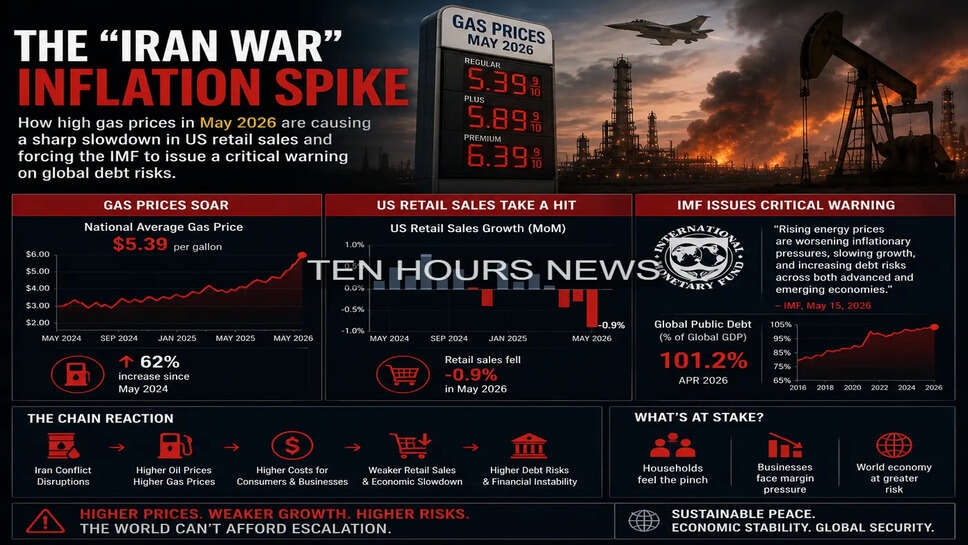
The economic fallout from the Iran War has reached a fever pitch this May. With the Strait of Hormuz—the world’s most critical energy artery—choked off by conflict, global oil markets are in a state of historic disruption. In the United States, the impact has moved from the gas pump to the checkout counter. As of May 14, 2026, gas prices have surged to an average of $4.53 per gallon, leaving American families with a "bill shock" that is siphoning money away from the broader economy and forcing a dramatic slowdown in retail activity.
According to new Commerce Department data, retail sales growth plummeted in April to just 0.5%, a sharp decline from the 1.6% growth seen in March. When gas station sales are excluded, the underlying retail strength is even weaker. This "spending freeze" is a direct result of energy-driven inflation. With more of every paycheck going into fuel tanks, consumers are slashing budgets for non-essentials like clothing, furniture, and electronics.
The IMF’s "Adverse Scenario" Warning
The crisis has become so severe that the International Monetary Fund (IMF) issued a critical update today, warning that the global economy is sliding into a dangerous "adverse scenario."
-
Growth Downgrades: The IMF has pared back its 2026 global growth forecast to 2.5% (down from 3.1%), with a "severe" warning that growth could drop to 2% if the maritime blockade persists.
-
Inflation Flare-ups: Global inflation is now projected to hit 6% in a worst-case outlook, driven by the 140% spike in LNG spot prices and the doubling of diesel and jet fuel costs.
-
Debt Traps: The Fund is currently in "active discussions" with over a dozen countries facing bankruptcy due to the combination of high energy costs and tightening financial conditions.
Economic Impact: A 2026 Snapshot
| Economic Marker | Pre-War (Early 2026) | Current Status (May 2026) |
| US Gas Price (Avg) | ~$3.18 / Gallon. | $4.53 / Gallon (up $1.35). |
| Brent Crude Oil | ~$75 / Barrel. | $120+ / Barrel. |
| Retail Sales Growth | 1.6% (March Peak). | 0.5% (April/May Slump). |
| US Consumer Price Index | 2.1% YoY. | 3.8% (3-year High). |
| Global Growth Forecast | 3.1%. | 2.5% (IMF Adverse Case). |
The "Strait-Jacket" on Global Trade
The heart of the problem remains the Strait of Hormuz, which normally handles 20% of global oil and 25% of the world's liquefied natural gas (LNG). The ongoing maritime blockade has created the "largest supply disruption in the history of the oil market," according to the IEA. While the U.S. has some domestic buffers, the volatility has sent a "grocery supply emergency" through the Middle East and an industrial shockwave through Europe, where the ECB has been forced to postpone interest rate cuts to combat the inflationary surge.
Conclusion
The Iran War Inflation Spike is no longer just a headline about military maneuvers; it is a kitchen-table crisis. The May slowdown in US retail sales is a warning sign that the "engine" of the global economy—the American consumer—is beginning to stall under the weight of $120 oil. With the IMF signaling that we are entering a period of heightened debt risk and potential recession, the "America First" trade and energy frameworks are facing their ultimate test. In 2026, the road to economic recovery must pass through the reopening of the world's energy lanes.
FAQs
Why are US gas prices so high in May 2026?
The war in Iran and the subsequent closure of the Strait of Hormuz have cut off a huge portion of the global oil supply, causing prices to jump by over $1.35 a gallon since the conflict began.
How has the war affected US shopping habits?
Retail sales growth has slowed significantly because people are spending much more on gas and basic utilities, leaving less money for "discretionary" items like new clothes or dining out.
What is the IMF's "Adverse Scenario"?
It is a projection where high energy prices stay elevated for longer, inflation expectations become unstable, and global growth slows to 2.5% or lower.
Is there a risk of a global recession?
Yes. The IMF has warned that a "severe" scenario could lead to just 2.0% global growth, which many economists consider a technical recession on a global scale.
What is the status of the Strait of Hormuz?
It remains largely blocked to commercial traffic, leading to massive disruptions in oil, gas, and fertilizer shipments that affect food and energy prices worldwide.
Will interest rates go down soon?
Likely not. Central banks like the Federal Reserve and the ECB have postponed planned rate cuts because they are worried that high energy prices will keep inflation too high.