
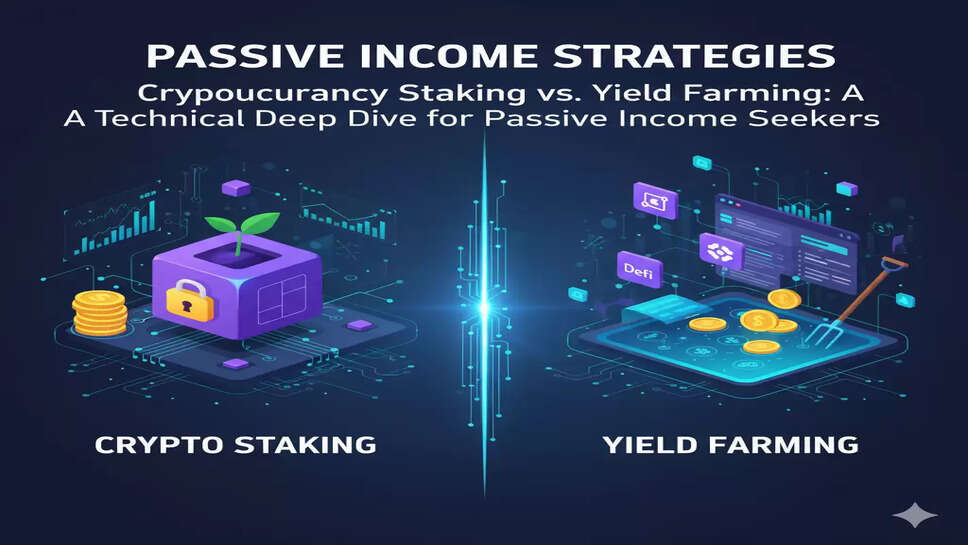
Cryptocurrency Staking vs. Yield Farming: A Technical Deep Dive for Passive Income Seekers
An in-depth, technical analysis of cryptocurrency Staking (Proof-of-Stake consensus) and Yield Farming (Automated Market Makers). We detail the underlying mechanisms, evaluate technical risks like Impermanent Loss and smart contract vulnerabilities, and compare rewards for advanced passive income strategies.
Introduction
The pursuit of passive income within the decentralized finance (DeFi) ecosystem has given rise to two dominant, yet fundamentally distinct, mechanisms: Staking and Yield Farming.1 While both strategies involve deploying crypto assets to generate returns, a technical deep dive reveals they operate on entirely different layers of the blockchain stack, are governed by separate risk profiles, and demand varying levels of technical expertise and active management. Staking is a direct function of a blockchain's core consensus mechanism, a foundational tool for network security.2 Yield Farming, conversely, is an application-layer financial innovation—a complex orchestration of lending, borrowing, and liquidity provision driven by sophisticated smart contracts.3 For the sophisticated passive income seeker, understanding the architectural difference between these two is paramount to effective risk mitigation and sustained profitability. This article provides a rigorous, technical comparison, dissecting the underlying consensus models and the economic and code-level vulnerabilities inherent in each approach.
I. Staking: The Core Mechanics of Proof-of-Stake Consensus
Staking is inextricably linked to the Proof-of-Stake (PoS) consensus mechanism, a revolutionary alternative to the energy-intensive Proof-of-Work (PoW) model.4 Its primary function is not income generation, but network security and transaction validation.5
The Validator Role and Consensus Mechanism
In a PoS system, the security of the network relies on Validators who commit, or "stake," a minimum required amount of the network's native cryptocurrency (e.g., 6$32$ ETH for Ethereum's Beacon Chain).7
A. Slot Selection and Block Finality
-
Staking as Collateral: The staked capital serves as economic collateral. By locking their assets, validators are incentivized to act honestly, as malicious behavior can result in a Slashing event—the irreversible forfeiture of a portion, or all, of their staked funds.8
-
Randomized Selection: Validators are probabilistically selected to propose and attest to new transaction blocks, with the probability of selection being proportional to the amount of crypto they have staked.9
-
Consensus and Finality: Once a block is proposed, other validators attest to its validity. Block Finality is achieved when a supermajority (e.g., two-thirds) of the total staked ETH attests to the block, adding it permanently to the blockchain.10
B. Rewards and Technical Risk Profile
Staking rewards are paid directly by the network protocol and primarily consist of:
-
Block Rewards: Newly minted tokens created as an incentive for block proposal and attestation.11
-
Transaction Fees: A portion of the fees users pay to execute transactions.12
Technical Risk Assessment for Staking:
-
Slashing Risk: The most critical technical risk. It is a protocol-level penalty triggered by validator misconduct, such as double-signing blocks or prolonged offline status (inactivity leak). This is an explicit, protocol-enforced loss of principal.
-
Protocol Risk: The risk that the underlying blockchain protocol itself contains a bug or is successfully attacked (e.g., a $51\%$ attack, which is significantly more capital-intensive in PoS than PoW due to slashing mechanics).
-
Lock-up and Liquidity: Most PoS chains impose a lock-up period or lengthy unbonding time. The inability to quickly access funds during a market crash introduces liquidity risk.
| Staking Parameter | Technical Details |
| Underlying Tech | Proof-of-Stake Consensus |
| Asset Required | Typically a single, native network token (e.g., ETH, SOL) |
| Risk of Loss | Slashing (Protocol-enforced), Protocol Attack |
| Source of Yield | Block rewards (Inflationary) and Transaction fees |
| Management Style | Highly Passive (after initial setup/delegation) |
II. Yield Farming: The Financial Engineering of Decentralized Finance (DeFi)
Yield Farming is a financial application layer strategy built on DeFi protocols, primarily Decentralized Exchanges (DEXs) and Lending/Borrowing platforms.13 Unlike staking, its function is capital utilization and liquidity incentivization.
A. The Automated Market Maker (AMM) Mechanism
The backbone of most Yield Farming is the Automated Market Maker (AMM), a smart contract system that allows digital assets to be traded automatically without permission or a traditional order book.14
-
Liquidity Pools (LPs): Users (Yield Farmers) deposit a pair of tokens (e.g., ETH and USDC) in a specific ratio into an LP.15 The combined value of all deposited tokens is known as the Total Value Locked (TVL).16
-
Smart Contract Functionality: The AMM smart contract uses a constant product formula, often $x \cdot y = k$, to determine the relative price of the two assets. The contract facilitates swaps between the tokens, and for this service, it charges a trading fee.
-
Liquidity Provider (LP) Tokens: Upon deposit, the farmer receives an LP Token, which represents their proportional share of the pool's assets and accumulated fees.17
B. Reward Mechanisms: Fees and Governance Tokens
Yield Farmers earn rewards from two primary sources:
-
Trading Fees: A percentage of the fees generated by every trade executed within the pool, distributed proportionally to LP token holders.
-
Governance/Incentive Tokens (Liquidity Mining): Many protocols reward LPs with the platform's native governance token (e.g., COMP, CRV).18 This is an additional incentive to attract liquidity and is often the source of the highest, yet most volatile, APYs.
III. The Technical Risks of Yield Farming: Impermanent Loss and Smart Contracts
The complexity of Yield Farming translates directly into a higher, multi-layered risk profile compared to staking.19
A. Impermanent Loss (IL): The Hidden Economic Risk
Impermanent Loss is the most critical and often misunderstood economic risk specific to providing liquidity to an AMM.
-
Definition: IL is the temporary dollar-value loss experienced by a liquidity provider when the price of the tokens they deposited changes compared to simply holding those tokens in their wallet.20
-
Mechanism: When the price ratio of the two tokens in the pool diverges from the initial deposit ratio, arbitrage traders interact with the AMM to bring the pool's ratio back in line with the external market price. This arbitrage activity effectively shifts value out of the pool, specifically taking more of the asset that has increased in value and leaving the LP with a larger quantity of the asset that has declined.
-
Formulaic Basis: The loss is mathematically quantifiable and is a function of the price change ($\alpha$) of the tokens. The dollar value of the loss increases exponentially as the price divergence widens. For a 50/50 pool, a $\mathbf{2\times}$ price change in one asset relative to the other results in a $\mathbf{5.7\%}$ IL. A $\mathbf{5\times}$ price change results in a $\mathbf{25.5\%}$ IL.
B. Smart Contract Vulnerabilities: The Code Risk
Yield Farming relies entirely on the execution of potentially complex and composable smart contracts. Code is law in DeFi, and errors or exploits are irreversible.
| Vulnerability Type | Technical Explanation | Mitigation Practice |
| Reentrancy Attack | A malicious contract repeatedly calls a function in the vulnerable contract to withdraw funds before the balance is updated (e.g., The DAO exploit). | Checks-Effects-Interactions Pattern: Update all state variables before any external contract calls. Utilize specialized reentrancy guard libraries. |
| Oracle Manipulation | Attacker uses a flash loan (uncollateralized, one-transaction loan) to temporarily manipulate the price of an asset on a vulnerable decentralized price oracle. | Use Time-Weighted Average Price (TWAP) oracles or rely on multiple, decentralized price feeds to prevent single-block manipulation.21 |
| Governance Attack / Rug Pull | Attackers (often protocol founders) gain control of the governance or administrative keys to halt withdrawals or drain the TVL from the smart contract, causing the token price to collapse. | Time-locks on administrative functions; thorough Audit Reports by reputable firms; transparent multisig wallet requirements. |
IV. Technical Comparison and Risk/Reward Evaluation
The choice between staking and yield farming hinges on a technical evaluation of risk tolerance, active management capability, and capital liquidity needs.
Technical Comparison Summary
| Feature | Staking (e.g., Ethereum Validator) | Yield Farming (e.g., AMM Liquidity Pool) |
| Core Function | Protocol Security & Consensus | Financial Liquidity Provision |
| Asset Requirement | Single Asset (Often native token) | Paired Assets (e.g., ETH/USDC) |
| Primary Risk | Slashing, Inactivity, Long Lock-up | Impermanent Loss (IL), Smart Contract Exploit |
| Yield Fluctuation | Generally Stable / Predictable | Highly Volatile (Depends on pool fees/incentives) |
| Expertise Required | Low to Moderate (via staking pools) | High (Requires understanding IL, contract security, gas fees) |
| Technical Term | Attestation, Slashing, Validator | LP Token, AMM, TVL, Arbitrage, Flash Loan |
Risk-Adjusted Reward Evaluation
The concept of Annual Percentage Yield (APY) is deceptive without considering the technical risks.
-
Staking Rewards (Lower APY, Higher Risk-Adjusted Return): The yield is generally lower (e.g., $4\%-8\%$ APY) but is paid in the same asset that is staked, minimizing market volatility exposure to the principal during the earning process. The loss mechanism (slashing) is explicit and event-driven. This leads to a higher risk-adjusted return for security-focused investors.
-
Yield Farming Rewards (Higher Nominal APY, Lower Risk-Adjusted Return): APYs can reach triple digits, but this nominal return must be offset by the potential for Impermanent Loss. A $100\%$ APY is functionally useless if the tokens in the pool diverge in price and the LP incurs a $30\%$ IL. The rewards are often paid in an inflationary governance token, which subjects the yield to hyper-inflationary selling pressure. The overall risk profile is significantly lower on a risk-adjusted basis due to the possibility of total loss from a smart contract exploit.
V. Advanced Strategies for Risk Mitigation
For the expert passive income seeker, minimizing the technical risks requires specific strategies:
A. For Staking: Liquid Staking Protocols
Protocols like Lido or Rocket Pool offer Liquid Staking. The staker receives a derivative token (stETH, rETH) upon staking their asset. This derivative token represents the staked principal plus accumulated rewards, is tradable, and can be deployed in other DeFi applications (e.g., as collateral in a lending protocol). This effectively eliminates the liquidity risk associated with the native PoS lock-up.
B. For Yield Farming: Stablecoin Pools and Audits
-
Stablecoin Pools: To completely neutralize the risk of Impermanent Loss, farmers focus on pools comprising two pegged assets (e.g., USDT/USDC/DAI). Since the prices of the tokens are algorithmically designed to remain near $1.00$, the price divergence ($\alpha$) is negligible, making IL minimal. Rewards in these pools are lower but far more predictable.
-
Due Diligence and Audits: Before deploying capital to any yield farming protocol, the only defense against smart contract risk is meticulous due diligence.22 Investors must verify that the protocol has undergone a comprehensive, third-party smart contract audit (e.g., by CertiK or Quantstamp) and that any administrative functions are protected by a public, verified time-lock.
Conclusion
The decision between staking and yield farming is a technical trade-off between protocol security and financial leverage. Staking is the foundational layer, offering predictable, network-aligned returns with the singular, high-impact risk of slashing and the low-impact risk of illiquidity. Yield Farming is a complex application of financial engineering that offers significantly higher nominal yields but introduces multiple layers of risk: the economic cost of Impermanent Loss, the binary risk of a smart contract exploit, and the active management burden of chasing sustainable yields.23 The educated passive income seeker prioritizes staking for its core stability or strategically utilizes stablecoin-based yield farming to achieve predictable returns while entirely eliminating the primary risk of Impermanent Loss. Deploying capital effectively in DeFi demands a technical understanding that goes beyond the promised APY and into the underlying consensus mechanism and contract code.