
CBDC Privacy Protocols: The 2026 Cryptographic Tools Designed to Secure Anonymity in the Federal Reserve’s Digital Dollar.
This article analyzes the specific cryptographic architecture proposed in 2026 to ensure the "Digital Dollar" maintains the privacy of physical cash while meeting modern regulatory standards for financial security.
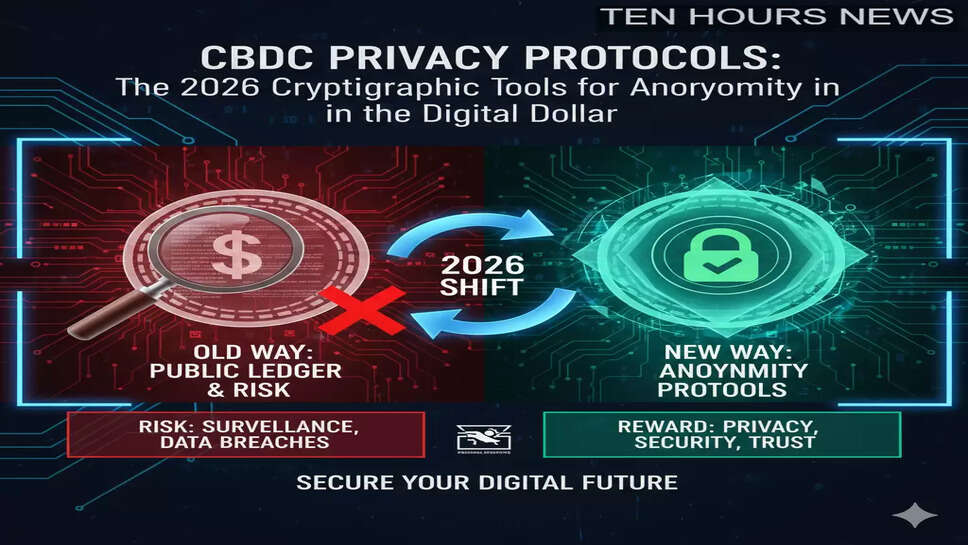
As of mid-January 2026, the debate surrounding the United States Central Bank Digital Currency (CBDC), or "Digital Dollar," has shifted from feasibility to functionality—specifically, how to reconcile the need for government oversight with the American public's demand for absolute financial privacy. While the Federal Reserve remains cautious, 2026 has seen the emergence of a definitive "Privacy Stack" of cryptographic tools designed to make the digital dollar as anonymous as a $20 bill. These protocols, collectively known as Privacy-Enhancing Technologies (PETs), are the cornerstone of a "Privacy-by-Design" architecture that ensures neither the Federal Reserve nor commercial banks can see who is spending money on what, while still allowing for the detection of systemic financial crimes.
The 2026 policy landscape, shaped by the landmark "Strengthening American Leadership in Digital Financial Technology" executive order, has mandated that any potential CBDC must protect lawful access to open blockchains and individual privacy. To meet these requirements, the Federal Reserve is exploring a hybrid model that uses advanced math to decouple identity from transaction data. This represents a historic departure from traditional digital banking, where every transaction is a permanent, visible entry on a centralized ledger.
Zero-Knowledge Proofs (ZKP): The "Witness Without Knowledge"
The most critical tool in the 2026 CBDC arsenal is the Zero-Knowledge Proof (ZKP). ZKPs allow one party (the spender) to prove to another party (the validator or the Fed) that a statement is true—such as "I have enough money for this transaction" or "I am a verified citizen"—without revealing any of the underlying data.
In a 2026 Digital Dollar transaction, ZKPs act as a "mathematical shield." When you buy a coffee, your digital wallet sends a proof to the network that the funds are legitimate and the transaction follows all legal rules. The Federal Reserve's nodes can verify the proof instantly, but they never see your wallet address, the merchant's identity, or the exact amount. This ensures Unlinkability, a core requirement of 2026 privacy standards, preventing anyone from tracking a user’s activities across different merchants.
Homomorphic Encryption: Computing on the Dark
While ZKPs protect the "who," Homomorphic Encryption is being deployed to protect the "how much." Traditionally, to perform any calculation on data (like adding a transaction to a balance), the data must be decrypted, making it vulnerable to surveillance. Homomorphic encryption allows the CBDC system to perform mathematical operations directly on encrypted data.
In the Federal Reserve’s 2026 pilot frameworks, this means the central ledger can update balances and verify that the total supply of digital dollars remains stable without the system ever "knowing" the actual values it is calculating. This allows for Programmable Compliance—auditors can verify that no money laundering is occurring at a systemic level without ever having access to the private financial lives of individual Americans. It is essentially an "auditable black box" that satisfies both the IRS and the privacy advocate.
Quantum-Safe Blind Signatures: The Digital Cash Experience
To replicate the specific privacy features of physical paper money, 2026 researchers have integrated Blind Signatures. First conceptualized in the 1980s but perfected for the 2026 quantum era, this protocol allows the central bank to "sign" a digital dollar (validating it as real currency) without seeing the serial number or the owner of that specific unit.
This technique ensures that once a digital dollar is issued to a citizen, its subsequent path through the economy is invisible to the issuer. In 2026, this has been refined into "Quantum-Safe" versions to ensure that even the most powerful future computers cannot de-anonymize past transactions. This creates a true "Digital Bearer Instrument," where possession of the private key is the only proof of ownership, just as physical possession is the only proof of owning a cash note.
The "Selective Disclosure" Compromise
The 2026 privacy debate has culminated in a "Tiered Anonymity" model. Recognizing that total, 100% anonymity for every transaction could facilitate massive-scale crime, the proposed cryptographic stack includes a Selective Disclosure layer. This allows users to remain anonymous for everyday, low-value transactions (e.g., under $1,000) while requiring a higher level of cryptographic "unblinding" for massive transfers that trigger standard anti-money laundering (AML) alerts.
This is managed through Multi-Party Computation (MPC), where the keys to "unblind" a suspicious transaction are split among several independent bodies (such as a federal judge, a privacy ombudsman, and the Treasury). No single agency can unilaterally peek into a citizen's digital wallet; a "mathematical consensus" of multiple branches of government is required to lift the veil of privacy, mirroring the traditional legal requirement for a search warrant.
Conclusion
The 2026 digital dollar is being built on the principle that privacy is not a "feature" to be added, but a fundamental property of the currency itself. Through the clever application of ZKPs, homomorphic encryption, and blind signatures, the Federal Reserve is attempting to build a system that is more private than a credit card but more secure than a suitcase of cash. As the US enters the final stages of its CBDC testing in late 2026, the success of these cryptographic tools will determine whether the digital dollar is embraced as a tool of freedom or rejected as a mechanism of state surveillance.
FAQs
Will the government be able to see my individual purchases with a CBDC? If the 2026 privacy protocols (like ZKPs and blind signatures) are fully implemented, the government would be mathematically unable to link your identity to your individual everyday purchases.
How is a Digital Dollar different from the money in my bank app? Money in your app is a liability of a private bank. A CBDC is a digital liability of the Federal Reserve itself, intended to be as "final" and private as physical cash.
Can these privacy tools be "hacked" or bypassed? The 2026 "Privacy Stack" uses "Quantum-Safe" cryptography designed to resist even the most advanced future computing attacks, though the "selective disclosure" rules for large transactions are governed by law, not just math.
Does a CBDC mean cash will be phased out? The Federal Reserve has stated throughout 2025 and 2026 that a digital dollar is intended to complement cash, not replace it, ensuring that those who prefer physical money still have access to it.
Is there a release date for the US Digital Dollar? As of January 15, 2026, there is no official launch date. The Federal Reserve is still in the "technical evaluation and pilot" phase, focusing heavily on these privacy protections before seeking Congressional approval.