
AI Identity Rights: The 2026 Legal Battle Over "Digital Likeness" in Hollywood
Discover the 2026 legal landscape of AI identity rights in Hollywood. Explore the NO FAKES Act, SAG-AFTRA’s 2026 contract battles, and the OBBBA Act’s role in digital likeness.
Jan 8, 2026, 04:01 IST
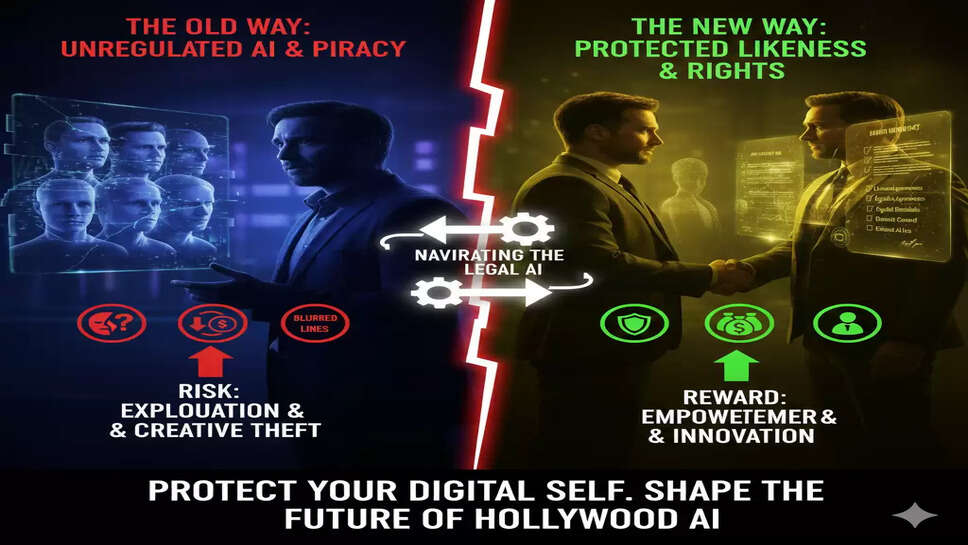
The dawn of 2026 has brought the entertainment industry to a definitive "legal event horizon" regarding the use of artificial intelligence and the protection of human identity. For decades, Hollywood operated on the principle that an actor’s physical presence was their primary asset, but the "Synthetic Summer" of 2025 proved that digital replicas are no longer just a visual effects trick—they are a viable, scalable, and highly controversial workforce. As of January 2026, the legal framework governing these "Digital Likenesses" is being forged in the fires of high-stakes litigation and federal preemption battles. With the official implementation of the NO FAKES Act of 2026 and the looming shadow of the One Big Beautiful Bill (OBBBA) Act, the industry is grappling with a fundamental question: Does a person’s identity belong to them, or can it be licensed, sold, and manipulated as a piece of corporate intellectual property? This battle is not just about the voices of superstars or the faces of deceased legends; it is about the "Digital Sovereignty" of every performer in the age of generative media.
The NO FAKES Act: A Federal Shield for Human Artistry
The most significant development in early 2026 is the full enforcement of the Nurture Originals, Foster Art, and Keep Entertainment Safe (NO FAKES) Act. After years of debate, this legislation has established the first-ever federal "Right of Publicity," effectively creating an intellectual property right in an individual’s voice and visual likeness. Prior to 2026, actors were forced to rely on a confusing patchwork of state laws that varied wildly between California, New York, and Tennessee. Under the NO FAKES Act, any individual or entity that produces or distributes an unauthorized "digital replica" in a performance can be held strictly liable for damages. A "digital replica" is defined in 2026 as a newly created, highly realistic representation of a person that is "readily identifiable" to the public. The act grants performers—and their heirs for up to 70 years after death—the exclusive right to authorize these replicas. This federal baseline has already triggered a wave of "Notice and Takedown" requests across major platforms, mirroring the DMCA process but specifically for AI-generated deepfakes and soundalikes.
The OBBBA Act and the Preemption War
While the NO FAKES Act provides a shield for performers, the One Big Beautiful Bill (OBBBA) Act of 2025 has introduced a layer of legal complexity that is causing chaos in the 2026 courts. The OBBBA Act was designed to streamline the adoption of "Frontier AI" and prevent a "regulatory thicket" from slowing down American tech innovation. A key provision of the OBBBA Act prohibits states from imposing "burdensome" requirements on AI models that do not apply to non-AI systems. In January 2026, the federal administration issued a landmark Executive Order specifically targeting state laws like California’s AB 2602 and AB 1836. The administration argues that strict state-level "Informed Consent" requirements for AI actors violate the OBBBA Act’s preemption clauses. Tech giants and major studios are using the OBBBA Act as a "Legal Shield," claiming that state laws requiring them to disclose the "DNA" of their training datasets or seeking to ban synthetic background performers are unconstitutional interferences with interstate commerce. This has created a direct conflict between state-level labor protections and federal-level innovation incentives, leaving the 2026 film season in a state of jurisdictional uncertainty.
SAG-AFTRA’s 2026 Renegotiation: The "Human First" Mandate
As the 2.5-year term of the historic 2023 TV/Theatrical Agreement expires in mid-2026, the SAG-AFTRA union is preparing for the "Contract of the Century." The 2026 negotiations are focused on two radical new concepts: "Living Residuals" and "Revocable Consent."
-
Living Residuals: The union is demanding that any time a digital replica is used—even for a split second of a background shot or a voiceover "correction"—the human performer must be compensated at a rate that mirrors a live day’s work.
-
Revocable Consent: Performers are pushing for the right to "un-license" their digital likeness. If an actor signs a deal in 2026 to have their AI replica used in a franchise, they want the legal power to revoke that consent if the franchise’s "moral direction" changes or if they simply no longer wish to be associated with the project. The studios, backed by the "Bio-Efficiency" goals of the OBBBA Act, are resisting these demands, arguing that once a digital asset is created, it should be treated like any other prop or visual effect. The 2026 standoff suggests that Hollywood may be heading toward another major work stoppage if a middle ground between "Human Artistry" and "Algorithmic Efficiency" cannot be found.